10:47 pm, Friday, 27 March 2026

Japan Women’s AFC Asian Cup Victory Crowns Japan Champion for Third Time

Sarakhon Report

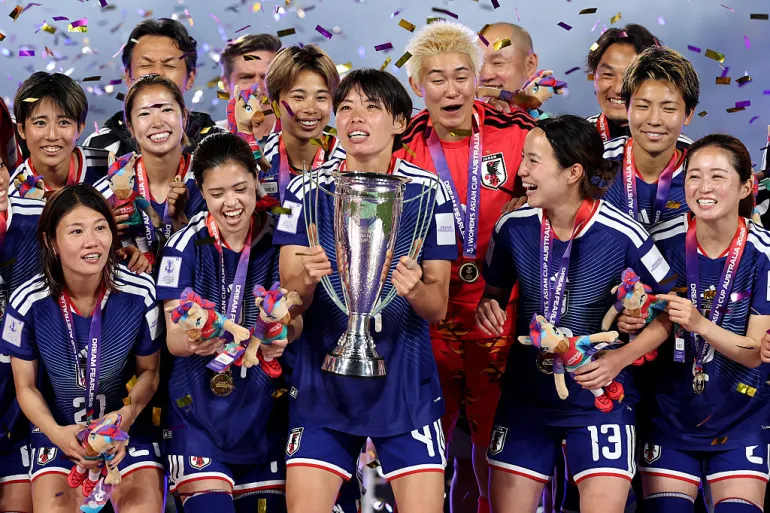
Japan defeats Australia in a final on home turf

Japan’s women’s national football team won the 2026 AFC Women’s Asian Cup, defeating hosts Australia in the final to claim their third title in the competition’s history. The match concluded the tournament that Australia co-hosted, and the result was a celebrated achievement for Japan’s program, which has long been one of the most technically accomplished in the Asian Football Confederation region. Japan’s victory extended a record of excellence in women’s football on the continent, where the team has consistently competed at the highest level across major tournaments. The result also added to Japan’s growing stature in international women’s football following their historic 2011 FIFA Women’s World Cup title and their runner-up finish in 2015, making this AFC title part of a sustained legacy rather than a one-off achievement.

Australia had entered the final as host nation, carrying the additional pressure and boost of playing in front of their home crowd. The Matildas, as Australia’s women’s national side is known, have experienced a surge in popularity and investment following their semifinal run at the 2023 FIFA Women’s World Cup, which was co-hosted by Australia and New Zealand and drew record domestic attendance figures. That visibility made the 2026 final a high-stakes occasion for Australian women’s football, and the defeat in front of home fans was a significant disappointment for a program that has worked hard to close the gap with Asia’s elite teams. The match was closely reported by Reuters and BBC Sport, underscoring the tournament’s growing international profile.

AFC Women’s Asian Cup and its regional significance

The AFC Women’s Asian Cup is the primary international women’s football tournament in Asia, bringing together the strongest national sides from across the continent. Past editions have been dominated by a handful of nations, with Japan, China, and South Korea having won the most titles historically. The 2026 edition was notable for its Australian co-hosting arrangement and for the quality of play across knockout stages. For Japan, the victory represented a continuation of a programme built on technical precision, high defensive organisation, and consistent player development pathways that have produced talent capable of competing at both the Asian and global level.

The result will likely have ripple effects across the region. Australia’s defeat at home may accelerate investment in youth development and elite coaching structures as the Football Australia federation looks ahead to the 2027 FIFA Women’s World Cup, for which Australia is again expected to be a strong contender. Japan’s win, by contrast, reinforces the strength of their domestic pipeline and the effectiveness of their national team coaching staff. Both programs will be closely watched as the sport builds toward the next World Cup cycle, with interest in women’s football across Asia at a historically high point following several years of expanding broadcast rights deals and rising club-level competition in the region.

07:13:26 pm, Friday, 27 March 2026

Japan Women’s AFC Asian Cup Victory Crowns Japan Champion for Third Time

07:13:26 pm, Friday, 27 March 2026

Japan defeats Australia in a final on home turf

Japan’s women’s national football team won the 2026 AFC Women’s Asian Cup, defeating hosts Australia in the final to claim their third title in the competition’s history. The match concluded the tournament that Australia co-hosted, and the result was a celebrated achievement for Japan’s program, which has long been one of the most technically accomplished in the Asian Football Confederation region. Japan’s victory extended a record of excellence in women’s football on the continent, where the team has consistently competed at the highest level across major tournaments. The result also added to Japan’s growing stature in international women’s football following their historic 2011 FIFA Women’s World Cup title and their runner-up finish in 2015, making this AFC title part of a sustained legacy rather than a one-off achievement.

Australia had entered the final as host nation, carrying the additional pressure and boost of playing in front of their home crowd. The Matildas, as Australia’s women’s national side is known, have experienced a surge in popularity and investment following their semifinal run at the 2023 FIFA Women’s World Cup, which was co-hosted by Australia and New Zealand and drew record domestic attendance figures. That visibility made the 2026 final a high-stakes occasion for Australian women’s football, and the defeat in front of home fans was a significant disappointment for a program that has worked hard to close the gap with Asia’s elite teams. The match was closely reported by Reuters and BBC Sport, underscoring the tournament’s growing international profile.

AFC Women’s Asian Cup and its regional significance

The AFC Women’s Asian Cup is the primary international women’s football tournament in Asia, bringing together the strongest national sides from across the continent. Past editions have been dominated by a handful of nations, with Japan, China, and South Korea having won the most titles historically. The 2026 edition was notable for its Australian co-hosting arrangement and for the quality of play across knockout stages. For Japan, the victory represented a continuation of a programme built on technical precision, high defensive organisation, and consistent player development pathways that have produced talent capable of competing at both the Asian and global level.

The result will likely have ripple effects across the region. Australia’s defeat at home may accelerate investment in youth development and elite coaching structures as the Football Australia federation looks ahead to the 2027 FIFA Women’s World Cup, for which Australia is again expected to be a strong contender. Japan’s win, by contrast, reinforces the strength of their domestic pipeline and the effectiveness of their national team coaching staff. Both programs will be closely watched as the sport builds toward the next World Cup cycle, with interest in women’s football across Asia at a historically high point following several years of expanding broadcast rights deals and rising club-level competition in the region.