

7:50 am, Friday, 17 April 2026

Humpback Whales Are Teaching Each Other New Hunting Skills — and Science Is Watching

Sarakhon Report

Bubble-net feeding spreads through social bonds in British Columbia

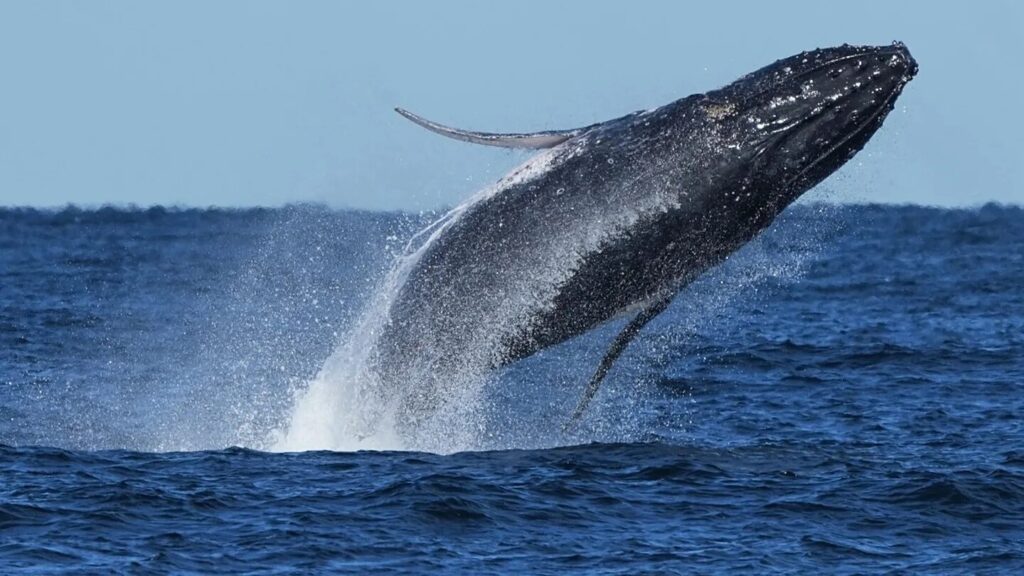
A new study published in the journal Proceedings of the Royal Society B has found that humpback whales are actively transmitting complex hunting behaviours to one another through social learning, offering one of the clearest real-time examples of animal culture ever documented in a large marine mammal. Researchers from the University of St. Andrews focused on a population of humpback whales in the Kitimat fjord system in Northern British Columbia, a group that was virtually wiped out by industrial whaling in the 20th century and has only recently begun to recover. Over two decades of observation, the team identified more than 500 individual whales using unique markings on their tail fins, and mapped the social connections between them in extraordinary detail. The behaviour under study is bubble-net feeding, a strategy in which a whale or group of whales dives beneath a school of fish or krill, swims in a slow circle while releasing air from the blowhole to create a rising curtain of bubbles, and then surges upward through the middle with an open mouth. The bubbles confuse and compress the prey, and simultaneously-made deep calls by other whales drive the fish toward the surface. It is one of the most intricate cooperative feeding strategies observed in any non-human animal, and it is far from universal: not all humpbacks practice it.

Whales observed sharing knowledge of new hunting techniques - UPI.com

Culture as survival tool; implications for conservation policy

What the research team found was that whales who had never been observed bubble-net feeding began adopting the behaviour after spending time with individuals who already practised it. The correlation between social proximity and skill transfer was strong and statistically significant. Lead researcher Eadin O’Mahony, a behavioural ecologist at St. Andrews, described the findings as evidence that the whales adapt to environmental pressures by learning from their social network rather than relying solely on genetic instinct. Marine biologist Philippa Brakes of Massey University in New Zealand, who was not involved in the study but commented on its findings, said the research demonstrates something important about how conservation is framed. Protecting a species requires protecting not just population numbers but the cultural knowledge carried within those populations, including learned behaviours that help communities survive in shifting environments. This matters especially in a period of rapid ocean change driven by climate. The Kitimat population being studied suffered enormous losses during industrial whaling, which means that whatever cultural knowledge was embedded in the pre-whaling community was also largely lost. The fact that bubble-net feeding is re-emerging and spreading suggests the animals have the capacity to rebuild collective knowledge across generations. Scientists say this kind of social resilience is one reason why humpbacks, whose total global population has grown from roughly 10,000 individuals at their lowest point to around 80,000 today, have made one of conservation’s most dramatic recoveries.


Humpback Whales Learn Feeding Technique from Peers | Live Science

06:57:32 pm, Tuesday, 17 March 2026

Humpback Whales Are Teaching Each Other New Hunting Skills — and Science Is Watching

06:57:32 pm, Tuesday, 17 March 2026

Bubble-net feeding spreads through social bonds in British Columbia

A new study published in the journal Proceedings of the Royal Society B has found that humpback whales are actively transmitting complex hunting behaviours to one another through social learning, offering one of the clearest real-time examples of animal culture ever documented in a large marine mammal. Researchers from the University of St. Andrews focused on a population of humpback whales in the Kitimat fjord system in Northern British Columbia, a group that was virtually wiped out by industrial whaling in the 20th century and has only recently begun to recover. Over two decades of observation, the team identified more than 500 individual whales using unique markings on their tail fins, and mapped the social connections between them in extraordinary detail. The behaviour under study is bubble-net feeding, a strategy in which a whale or group of whales dives beneath a school of fish or krill, swims in a slow circle while releasing air from the blowhole to create a rising curtain of bubbles, and then surges upward through the middle with an open mouth. The bubbles confuse and compress the prey, and simultaneously-made deep calls by other whales drive the fish toward the surface. It is one of the most intricate cooperative feeding strategies observed in any non-human animal, and it is far from universal: not all humpbacks practice it.

Whales observed sharing knowledge of new hunting techniques - UPI.com

Culture as survival tool; implications for conservation policy

What the research team found was that whales who had never been observed bubble-net feeding began adopting the behaviour after spending time with individuals who already practised it. The correlation between social proximity and skill transfer was strong and statistically significant. Lead researcher Eadin O’Mahony, a behavioural ecologist at St. Andrews, described the findings as evidence that the whales adapt to environmental pressures by learning from their social network rather than relying solely on genetic instinct. Marine biologist Philippa Brakes of Massey University in New Zealand, who was not involved in the study but commented on its findings, said the research demonstrates something important about how conservation is framed. Protecting a species requires protecting not just population numbers but the cultural knowledge carried within those populations, including learned behaviours that help communities survive in shifting environments. This matters especially in a period of rapid ocean change driven by climate. The Kitimat population being studied suffered enormous losses during industrial whaling, which means that whatever cultural knowledge was embedded in the pre-whaling community was also largely lost. The fact that bubble-net feeding is re-emerging and spreading suggests the animals have the capacity to rebuild collective knowledge across generations. Scientists say this kind of social resilience is one reason why humpbacks, whose total global population has grown from roughly 10,000 individuals at their lowest point to around 80,000 today, have made one of conservation’s most dramatic recoveries.

Humpback Whales Learn Feeding Technique from Peers | Live Science