4:01 am, Monday, 12 January 2026

Jagannath University’s Jamaat Student Wing Sweep: What It Signals for a One-Sided Bangldesh Elections


Swadesh Roy

Even before the aftertaste faded of arrangements for Tarique Rahman’s regal return, of not only Begum Zia’s funeral being held after long preparation, and of a cat story, the “Jebu Kahini,” becoming the main headline in the country’s top newspaper Jagannath University held its student union election. And at this moment, Islami Chhatra Shibir, the student organization of Bangladesh Jamaat-e-Islami, has won the entire panel.

So it is only natural that, in the post–5 August period, Jagannath University’s result must be seen a little differently from the series of campus victories Islami Chhatra Shibir had been registering. Not that it is so different. Rather, one could say: in the politics of post–5 August Bangladesh, where, in the absence of the Awami League, Jamaat-e-Islami had been in the driving seat, this Shibir victory is itself the expression that, even after the arrangements for Tarique Rahman’s regal return and all efforts centered on Begum Zia, Jamaat-e-Islami remains in that driving seat.

After Sheikh Hasina left the country on 5 August, the army chief sat at the driving seat of national politics and state power for some time. And that was only natural.

Even though Muhammad Yunus has said that 5 August was the result of his amazing, meticulously designed plan, he has nevertheless admitted that without the army’s support, they could not have succeeded. In this case, at least, Muhammad Yunus has not spoken an untruth because the people of this country have seen it.
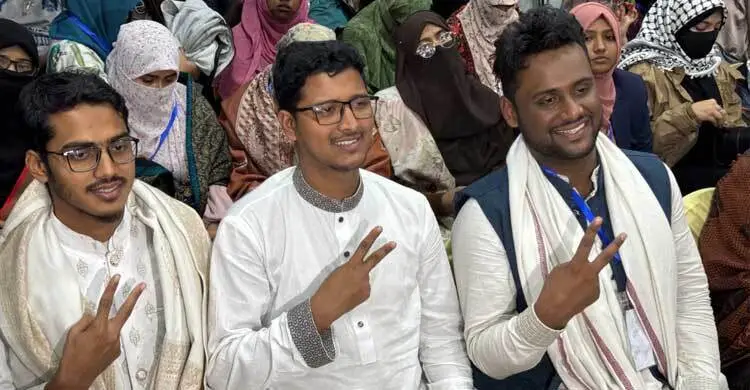
শিবির-সমর্থিত প্যানেলের বড় জয়

In any case, within hours of Sheikh Hasina’s departure on 5 August, Bangladesh Jamaat-e-Islami moved into the driver’s seat as the political force managing politics and the state.

Not only since Bangladesh’s independence, but in Jamaat-e-Islami’s own history, this is the first time it has arrived at such a position. Jamaat-e-Islami’s natural ally in Bangladesh, the Bangladesh Nationalist Party, had long occupied the driver’s seat of this strand of politics. Jamaat-e-Islami was the co-passenger. But after 5 August, that seat, and that position, has changed.

And BNP, along with its civil society allies, has understood that the seat has changed. That is why, even after accepting all of Muhammad Yunus’s reforms and signing the July Charter, they are trying to shift their position. Most recently, on the one hand, they have maintained their relationship with Jamaat-e-Islami. On the other hand, by changing international allies or changing faces to some extent, they are attempting to seize that driver’s seat from Jamaat-e-Islami.

But in Bangladesh’s politics, divided into two camps, the camp whose support allowed BNP, for so long, to keep Jamaat-e-Islami in a side role while it played the central role, the hero’s role, that hero, that main character, after 5 August and in the absence of the Awami League, has been taken by Jamaat-e-Islami. Here, the word “taken” is not, in reality, the most accurate usage. It must be used because Jamaat-e-Islami did not receive this driver’s seat through an election, but rather, through an event. Within that event, there was bloodshed involving police, RAB, members of the armed forces, armed cadres, and ordinary people.

Yet even so, it can be said: in Bangladesh’s politics, in the absence of the Awami League and genuine supporters of the Liberation War, this was inevitable.

A long historical analysis can be done on this. Still, without going there, one can simply say: BNP and Jamaat-e-Islami have, jointly, practiced a politics for so long, and ownership of the core part of that politics belongs to Jamaat-e-Islami. That core portion is quite hard. BNP has moved ahead, remaining in the central role, by attaching many soft layers to the hard body. And Jamaat-e-Islami has waited for the required measure of society, and for the necessary number of people to undergo a psychological transformation.

In the politics of Ziaur Rahman, Ershad, and Sheikh Hasina, there was, indirectly, a place for Jamaat to prepare the ground. On the other hand, in Khaleda Zia’s politics, there was a place for Jamaat-e-Islami to prepare the ground directly. All of this together, arriving 54 years after independence, in the post–5 August situation and in the absence of the Awami League, Jamaat-e-Islami has now, in effect, taken from BNP the leadership of its share within Bangladesh’s “divided” politics.

BNP and its civil society supporters, because they understand the matter, are presenting many things, including various so-called surveys, that if there is voting without the Awami League, Awami League activists and supporters will, in large part, vote for BNP.

But the reality is: the Awami League’s hard vote, even after any disaster, remains above 30 percent. A small portion of them, who are voters of Bangabandhu Sheikh Mujibur Rahman, are still alive. The rest are voters of Sheikh Hasina. To the current rulers, to BNP and Jamaat-e-Islami, even to the Communist Party, Sheikh Hasina may be a fascist, but if you calculate that Awami League 30 percent by age, then for a good 28 percent, their beloved leader is Sheikh Hasina. They consider her successful. It is not merely that they see her as the leader of widow allowances and the Padma Bridge, they are blind to her.

So, in a vote without the Awami League, taking these voters to polling centers becomes difficult. Only if they can be forced to polling centers and made, in front of everyone, to stamp the ballot, then perhaps BNP can get their votes.

Besides, the easy arithmetic being done is that BNP is comparatively more liberal than Jamaat-e-Islami, so Awami Leaguers will vote for them. And indeed some such voters are being seen. These voters, or this portion of the urban middle class, are in fact BNP’s own. Over the last fifteen years, they abandoned courage for the sake of facilities and benefits, joined compromise, and drank honey. But in terms of numbers, they are not a factor of that kind within vote politics.

Moreover, the Awami League is a political party that has moved through many rises and falls. So its real activists, even if they are neglected by the party when it is in power, remain steadfast in their politics.
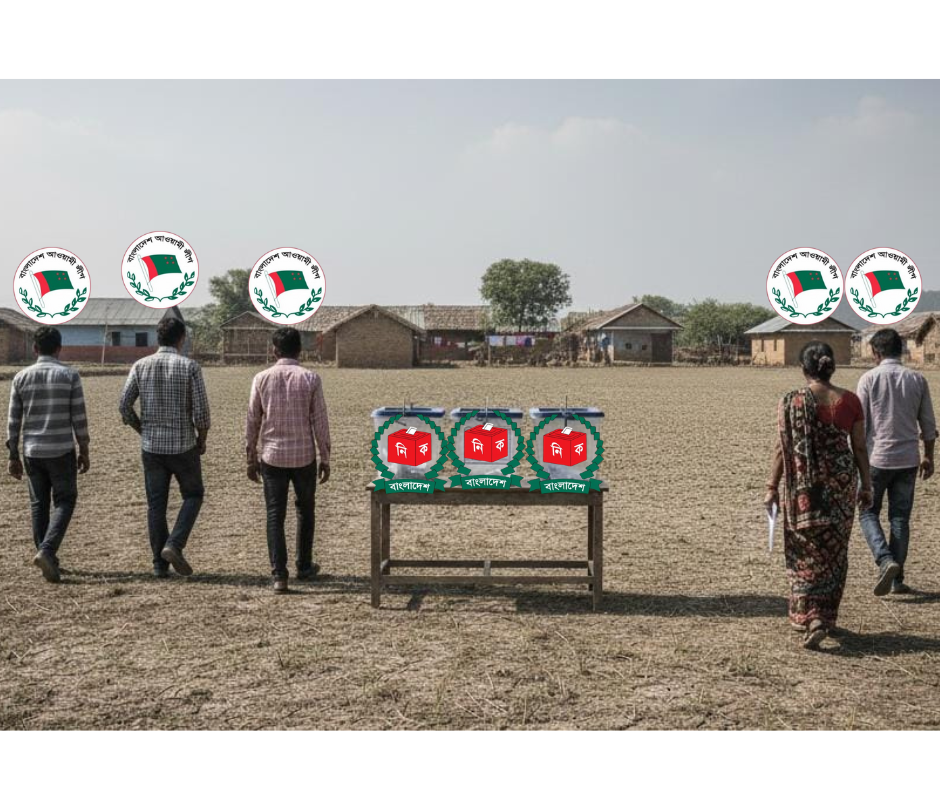
Many say of them that their master is elsewhere. That is not correct either. If one is to say that they have a master, for some, then that is Bangabandhu Sheikh Mujibur Rahman and Sheikh Hasina. And in the calculations of politics and voting, they will calculate their profit and loss with Sheikh Mujib and Sheikh Hasina as the center point.

For this reason, in any election without the Awami League, the arithmetic of votes must be calculated by subtracting Awami League voters. In this arithmetic grid, it is evident that Jamaat-e-Islami is winning every chess move in student union elections. Even after so much surrounding Tarique Rahman’s coming to the country and Begum Zia’s death, in the Jagannath University student union election, Jamaat’s student organization has preserved its winning streak with dominance intact. Which is a big signal.

In post–5 August student politics, many naturally assumed: Chhatra League is gone; now it is Chhatra Dal. The arithmetic did not match. Those who calculate this country’s politics outside emotion have, gradually from the night of 5 August, treated this mismatch as natural.

If there is a national election without the Awami League, then the closer the election comes, the more clearly it is becoming that one thread after another will unravel from Jamaat-e-Islami’s spool.

Writer: Journalist awarded the highest state honor; Editor, SarakhonThe Present World.

08:38:12 pm, Sunday, 11 January 2026

Jagannath University’s Jamaat Student Wing Sweep: What It Signals for a One-Sided Bangldesh Elections

08:38:12 pm, Sunday, 11 January 2026

Even before the aftertaste faded of arrangements for Tarique Rahman’s regal return, of not only Begum Zia’s funeral being held after long preparation, and of a cat story, the “Jebu Kahini,” becoming the main headline in the country’s top newspaper Jagannath University held its student union election. And at this moment, Islami Chhatra Shibir, the student organization of Bangladesh Jamaat-e-Islami, has won the entire panel.

So it is only natural that, in the post–5 August period, Jagannath University’s result must be seen a little differently from the series of campus victories Islami Chhatra Shibir had been registering. Not that it is so different. Rather, one could say: in the politics of post–5 August Bangladesh, where, in the absence of the Awami League, Jamaat-e-Islami had been in the driving seat, this Shibir victory is itself the expression that, even after the arrangements for Tarique Rahman’s regal return and all efforts centered on Begum Zia, Jamaat-e-Islami remains in that driving seat.

After Sheikh Hasina left the country on 5 August, the army chief sat at the driving seat of national politics and state power for some time. And that was only natural.

Even though Muhammad Yunus has said that 5 August was the result of his amazing, meticulously designed plan, he has nevertheless admitted that without the army’s support, they could not have succeeded. In this case, at least, Muhammad Yunus has not spoken an untruth because the people of this country have seen it.

শিবির-সমর্থিত প্যানেলের বড় জয়

In any case, within hours of Sheikh Hasina’s departure on 5 August, Bangladesh Jamaat-e-Islami moved into the driver’s seat as the political force managing politics and the state.

Not only since Bangladesh’s independence, but in Jamaat-e-Islami’s own history, this is the first time it has arrived at such a position. Jamaat-e-Islami’s natural ally in Bangladesh, the Bangladesh Nationalist Party, had long occupied the driver’s seat of this strand of politics. Jamaat-e-Islami was the co-passenger. But after 5 August, that seat, and that position, has changed.

And BNP, along with its civil society allies, has understood that the seat has changed. That is why, even after accepting all of Muhammad Yunus’s reforms and signing the July Charter, they are trying to shift their position. Most recently, on the one hand, they have maintained their relationship with Jamaat-e-Islami. On the other hand, by changing international allies or changing faces to some extent, they are attempting to seize that driver’s seat from Jamaat-e-Islami.

But in Bangladesh’s politics, divided into two camps, the camp whose support allowed BNP, for so long, to keep Jamaat-e-Islami in a side role while it played the central role, the hero’s role, that hero, that main character, after 5 August and in the absence of the Awami League, has been taken by Jamaat-e-Islami. Here, the word “taken” is not, in reality, the most accurate usage. It must be used because Jamaat-e-Islami did not receive this driver’s seat through an election, but rather, through an event. Within that event, there was bloodshed involving police, RAB, members of the armed forces, armed cadres, and ordinary people.

Yet even so, it can be said: in Bangladesh’s politics, in the absence of the Awami League and genuine supporters of the Liberation War, this was inevitable.

A long historical analysis can be done on this. Still, without going there, one can simply say: BNP and Jamaat-e-Islami have, jointly, practiced a politics for so long, and ownership of the core part of that politics belongs to Jamaat-e-Islami. That core portion is quite hard. BNP has moved ahead, remaining in the central role, by attaching many soft layers to the hard body. And Jamaat-e-Islami has waited for the required measure of society, and for the necessary number of people to undergo a psychological transformation.

In the politics of Ziaur Rahman, Ershad, and Sheikh Hasina, there was, indirectly, a place for Jamaat to prepare the ground. On the other hand, in Khaleda Zia’s politics, there was a place for Jamaat-e-Islami to prepare the ground directly. All of this together, arriving 54 years after independence, in the post–5 August situation and in the absence of the Awami League, Jamaat-e-Islami has now, in effect, taken from BNP the leadership of its share within Bangladesh’s “divided” politics.

BNP and its civil society supporters, because they understand the matter, are presenting many things, including various so-called surveys, that if there is voting without the Awami League, Awami League activists and supporters will, in large part, vote for BNP.

But the reality is: the Awami League’s hard vote, even after any disaster, remains above 30 percent. A small portion of them, who are voters of Bangabandhu Sheikh Mujibur Rahman, are still alive. The rest are voters of Sheikh Hasina. To the current rulers, to BNP and Jamaat-e-Islami, even to the Communist Party, Sheikh Hasina may be a fascist, but if you calculate that Awami League 30 percent by age, then for a good 28 percent, their beloved leader is Sheikh Hasina. They consider her successful. It is not merely that they see her as the leader of widow allowances and the Padma Bridge, they are blind to her.

So, in a vote without the Awami League, taking these voters to polling centers becomes difficult. Only if they can be forced to polling centers and made, in front of everyone, to stamp the ballot, then perhaps BNP can get their votes.

Besides, the easy arithmetic being done is that BNP is comparatively more liberal than Jamaat-e-Islami, so Awami Leaguers will vote for them. And indeed some such voters are being seen. These voters, or this portion of the urban middle class, are in fact BNP’s own. Over the last fifteen years, they abandoned courage for the sake of facilities and benefits, joined compromise, and drank honey. But in terms of numbers, they are not a factor of that kind within vote politics.

Moreover, the Awami League is a political party that has moved through many rises and falls. So its real activists, even if they are neglected by the party when it is in power, remain steadfast in their politics.

Many say of them that their master is elsewhere. That is not correct either. If one is to say that they have a master, for some, then that is Bangabandhu Sheikh Mujibur Rahman and Sheikh Hasina. And in the calculations of politics and voting, they will calculate their profit and loss with Sheikh Mujib and Sheikh Hasina as the center point.

For this reason, in any election without the Awami League, the arithmetic of votes must be calculated by subtracting Awami League voters. In this arithmetic grid, it is evident that Jamaat-e-Islami is winning every chess move in student union elections. Even after so much surrounding Tarique Rahman’s coming to the country and Begum Zia’s death, in the Jagannath University student union election, Jamaat’s student organization has preserved its winning streak with dominance intact. Which is a big signal.

In post–5 August student politics, many naturally assumed: Chhatra League is gone; now it is Chhatra Dal. The arithmetic did not match. Those who calculate this country’s politics outside emotion have, gradually from the night of 5 August, treated this mismatch as natural.

If there is a national election without the Awami League, then the closer the election comes, the more clearly it is becoming that one thread after another will unravel from Jamaat-e-Islami’s spool.

Writer: Journalist awarded the highest state honor; Editor, SarakhonThe Present World.