

Astronomers Capture a Nova’s Blast in Unprecedented Detail, Challenging Old Theories

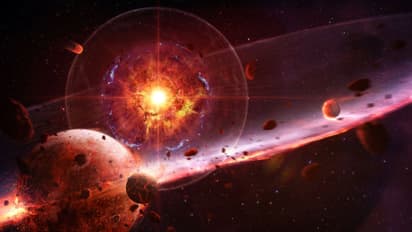
A nova has always been described as a sudden flare—one violent release of energy that briefly makes a star system appear brighter in the night sky. New high-resolution imaging now suggests the early moments can be far more complicated, with multiple outflows, shifting structures, and shock-driven bursts of energy that unfold in stages rather than a single clean blast.
A clearer look at a fast-changing explosion
Researchers used a technique that combines light from multiple telescopes to produce extremely sharp images of the earliest phases of nova eruptions. This matters because the first days after a nova are usually the hardest to observe: the ejected material is small, rapidly evolving, and easy to miss with conventional methods.
In a nova, a white dwarf pulls hydrogen-rich gas from a nearby companion star. That gas builds up until the surface ignition triggers a runaway reaction. The system brightens quickly, but what happens in the ejecta—the material thrown outward—has been largely reconstructed indirectly. With detailed imaging, scientists can now watch the geometry of the outflow as it forms.
Two novae, two very different stories
The team observed two novae that erupted in 2021: one that peaked and faded extremely fast, and another that built slowly and stayed bright for months. The fast nova reached peak brightness in less than a day and then dimmed within days. Images show its eruption was not spherical. Instead, distinct flows formed in different directions, with an additional structure radiating across them—strong evidence that multiple streams of ejected material were interacting.
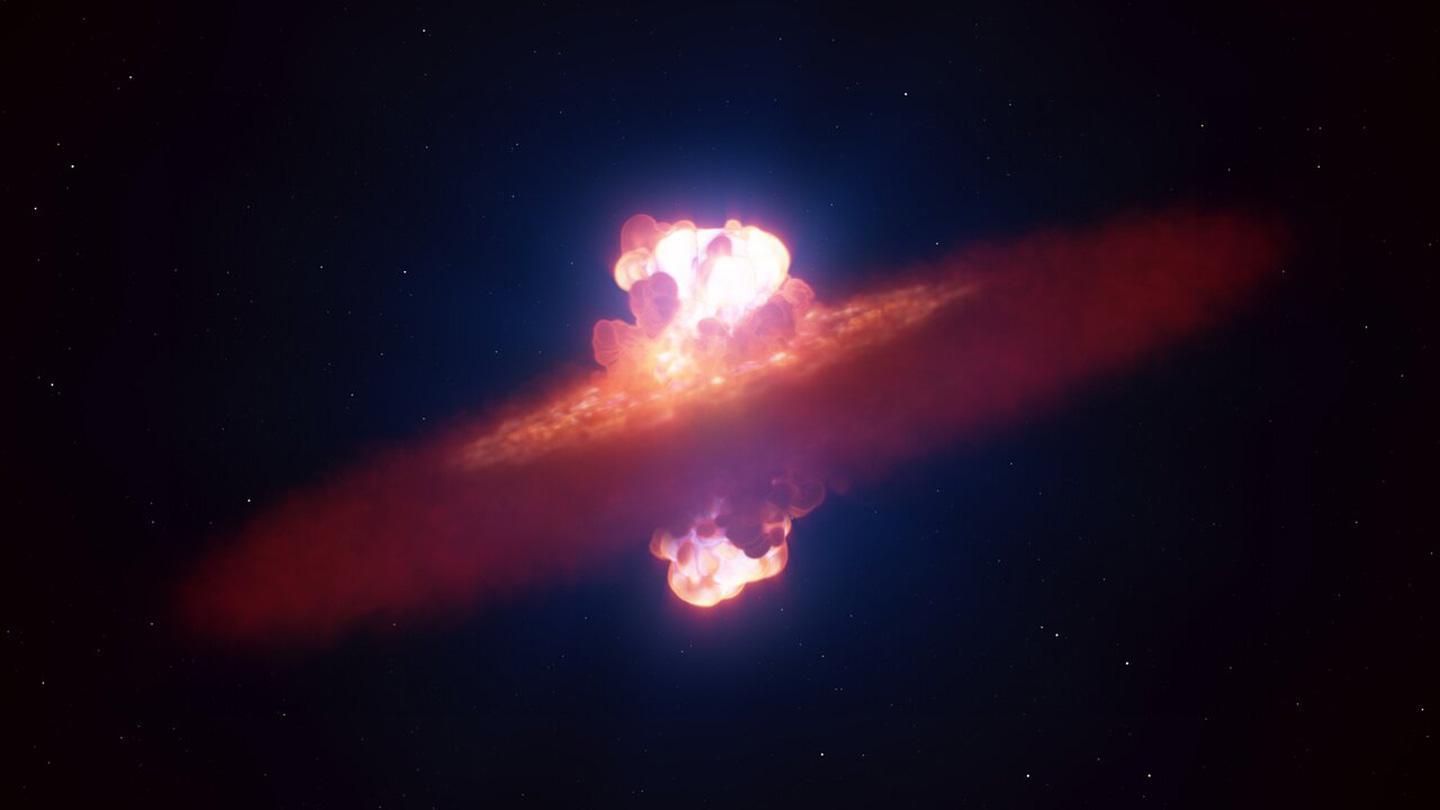
That interaction matters because colliding streams can generate powerful shock waves. Those shocks are a leading explanation for why some novae produce high-energy emissions. The observations align with the idea that the nova’s “blast” may include a sequence of ejections at different speeds, creating internal collisions that light up the system in energetic bursts.
The slower nova delivered a different surprise. Early images showed a compact central region rather than a huge, steadily expanding shell that would be expected if most material had been expelled immediately. The findings suggest a large portion of the gas may have lingered around the system longer than expected, surrounding the binary like a shared envelope before later being pushed outward, again producing shocks and high-energy signals.
Why it changes what scientists look for next
For years, astronomers have detected high-energy radiation from many novae, but the physical picture has been evolving. These new images reinforce a view of novae as dynamic, multi-step events—useful natural laboratories for studying shock physics, particle acceleration, and how tightly bound star systems exchange mass.
Beyond novae themselves, the results could improve how scientists interpret sudden brightening events across the sky, especially as modern surveys find transient phenomena faster than ever. The main takeaway is that “a nova” is not always a single moment. It can be a sequence—structured, directional, and shock-driven.