
3:09 am, Tuesday, 14 April 2026

Clean Energy Investment Hit a Record $2.3 Trillion in 2025 Despite Policy Headwinds

Sarakhon Report

Electric transport leads; clean energy now outpaces fossil fuels for second year

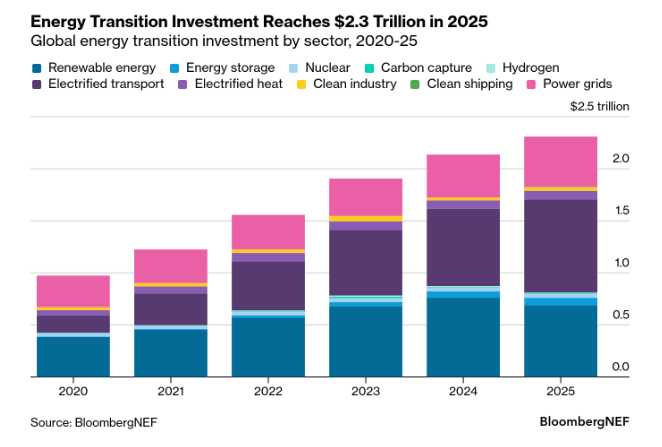
Global investment in the energy transition reached $2.3 trillion in 2025, an eight percent increase from the previous year and the highest figure ever recorded, according to BloombergNEF’s annual Energy Transition Investment Trends report published in January 2026. The result is remarkable for the resistance it demonstrates to a hostile policy environment in the United States under the Trump administration, which moved aggressively to curtail federal support for wind and solar and withdrew the country from multilateral climate frameworks. Clean energy investment — spanning renewable power, electric vehicles, grid upgrades, energy storage, and low-carbon fuels — outpaced fossil fuel supply investment for the second consecutive year, with the gap between the two widening to $102 billion from $85 billion in 2024. The largest single category of investment was electrified transport at $893 billion, up 21 percent from the prior year as electric vehicle sales globally reached approximately 20.7 million units in 2025, meaning roughly one in every four new cars sold worldwide was electric. Grid investment reached $483 billion, a figure that researchers say is still falling short of what is needed to connect new clean energy capacity reliably to end users, particularly in developing economies.
China leads; US retreats; Europe surges into offshore wind

The Asia-Pacific region accounted for 47 percent of global energy transition investment in 2025, with China maintaining its position as the world’s largest single market at approximately $800 billion. However, for the first time since 2013, China’s investment in renewables fell, dropping nearly ten percent as new power market regulations introduced uncertainty for large-scale wind and solar developers by shifting them from guaranteed subsidised pricing to competitive market rates. India was a bright spot, with its investment climbing 15 percent to $68 billion, driven by solar capacity expansion, grid upgrades, and electrification projects. US investment grew by a modest 3.5 percent to $378 billion despite the administration’s policy rollbacks, although new analysis suggests the One Big Beautiful Bill Act signed in July 2025, which accelerated the expiration of clean energy tax credits, will likely slow future project pipelines substantially. European investment rose 18 percent to $455 billion, the largest single-region increase, driven heavily by a strategic pivot toward North Sea offshore wind as developers reallocated capital away from the uncertain US market. Researchers at BloombergNEF project that global energy transition investment could approach $2.9 trillion annually over the next five years under base-case scenarios. Within 2026 itself, the landscape is further complicated by the Hormuz crisis, which has reinforced the strategic case for domestic clean energy as a pillar of energy security, particularly across Asia-Pacific nations facing acute exposure to the disrupted Gulf supply corridor.

Global green tech investments hit record $2.3 trillion despite political  headwinds - Los Angeles Times

06:49:46 pm, Tuesday, 17 March 2026

Clean Energy Investment Hit a Record $2.3 Trillion in 2025 Despite Policy Headwinds

06:49:46 pm, Tuesday, 17 March 2026

Electric transport leads; clean energy now outpaces fossil fuels for second year

Global investment in the energy transition reached $2.3 trillion in 2025, an eight percent increase from the previous year and the highest figure ever recorded, according to BloombergNEF’s annual Energy Transition Investment Trends report published in January 2026. The result is remarkable for the resistance it demonstrates to a hostile policy environment in the United States under the Trump administration, which moved aggressively to curtail federal support for wind and solar and withdrew the country from multilateral climate frameworks. Clean energy investment — spanning renewable power, electric vehicles, grid upgrades, energy storage, and low-carbon fuels — outpaced fossil fuel supply investment for the second consecutive year, with the gap between the two widening to $102 billion from $85 billion in 2024. The largest single category of investment was electrified transport at $893 billion, up 21 percent from the prior year as electric vehicle sales globally reached approximately 20.7 million units in 2025, meaning roughly one in every four new cars sold worldwide was electric. Grid investment reached $483 billion, a figure that researchers say is still falling short of what is needed to connect new clean energy capacity reliably to end users, particularly in developing economies.

China leads; US retreats; Europe surges into offshore wind

The Asia-Pacific region accounted for 47 percent of global energy transition investment in 2025, with China maintaining its position as the world’s largest single market at approximately $800 billion. However, for the first time since 2013, China’s investment in renewables fell, dropping nearly ten percent as new power market regulations introduced uncertainty for large-scale wind and solar developers by shifting them from guaranteed subsidised pricing to competitive market rates. India was a bright spot, with its investment climbing 15 percent to $68 billion, driven by solar capacity expansion, grid upgrades, and electrification projects. US investment grew by a modest 3.5 percent to $378 billion despite the administration’s policy rollbacks, although new analysis suggests the One Big Beautiful Bill Act signed in July 2025, which accelerated the expiration of clean energy tax credits, will likely slow future project pipelines substantially. European investment rose 18 percent to $455 billion, the largest single-region increase, driven heavily by a strategic pivot toward North Sea offshore wind as developers reallocated capital away from the uncertain US market. Researchers at BloombergNEF project that global energy transition investment could approach $2.9 trillion annually over the next five years under base-case scenarios. Within 2026 itself, the landscape is further complicated by the Hormuz crisis, which has reinforced the strategic case for domestic clean energy as a pillar of energy security, particularly across Asia-Pacific nations facing acute exposure to the disrupted Gulf supply corridor.

Global green tech investments hit record $2.3 trillion despite political  headwinds - Los Angeles Times