9:09 pm, Tuesday, 2 December 2025

INDONESIANS BLAME ILLEGAL LOGGING AS FLOODS TURN VILLAGES INTO MUD FIELDS

Sarakhon Report

Deforested hillsides collapse after record rains

As rescue crews continue to search for survivors of Indonesia’s latest deadly floods, anger is rising in hard-hit communities over what locals call “mischievous hands” in the forests above their homes. Days of intense rainfall triggered flash floods and landslides that ripped through rural areas of West Sumatra, burying houses, roads and farmland under thick layers of mud and debris. Residents say they warned for years that uncontrolled logging and land clearing on steep slopes would end in tragedy. Now, with scores dead and many more missing, those warnings sound painfully prophetic.

In villages like Palembayan in Agam regency, satellite images and drone footage show bare, scarred hills where dense forest once absorbed heavy rains. Instead of soaking into soil and tree roots, runoff cascaded down exposed slopes, picking up rocks, felled trunks and pieces of homes in its path. Witnesses describe hearing a roar “like a jet engine” before a wall of water and mud swept away entire clusters of houses. For families who lost loved ones, the link between what happened upstream and the destruction downstream feels obvious, even if formal investigations will take months.

Men stand on logs swept away by flash flood in Batang Toru, North Sumatra, Indonesia, Tuesday, Dec. 2, 2025. (AP Photo/Binsar Bakkara)

Environmental groups have documented widespread encroachment into protected areas across parts of Sumatra. They accuse local officials of turning a blind eye as plantations, small-scale mines and illegal timber operations push ever higher into fragile terrain. In some cases, villagers say forests were replaced by shallow-rooted crops that offer little resistance when slopes become saturated. Indonesian disaster-management experts have repeatedly warned that such changes magnify the impact of extreme weather, but enforcement has often struggled against economic pressures and corruption.

The government has promised accountability. Senior ministers have visited the affected provinces and ordered a review of permits for logging and plantation concessions near disaster zones. Authorities say they will investigate whether companies or individuals violated land-use rules, and whether local agencies failed to act on early warning signs such as smaller landslides and blocked rivers. Critics argue that Indonesia has launched similar crackdowns after previous disasters, only for public attention to drift away once the headlines fade. This time, they say, real consequences must follow.

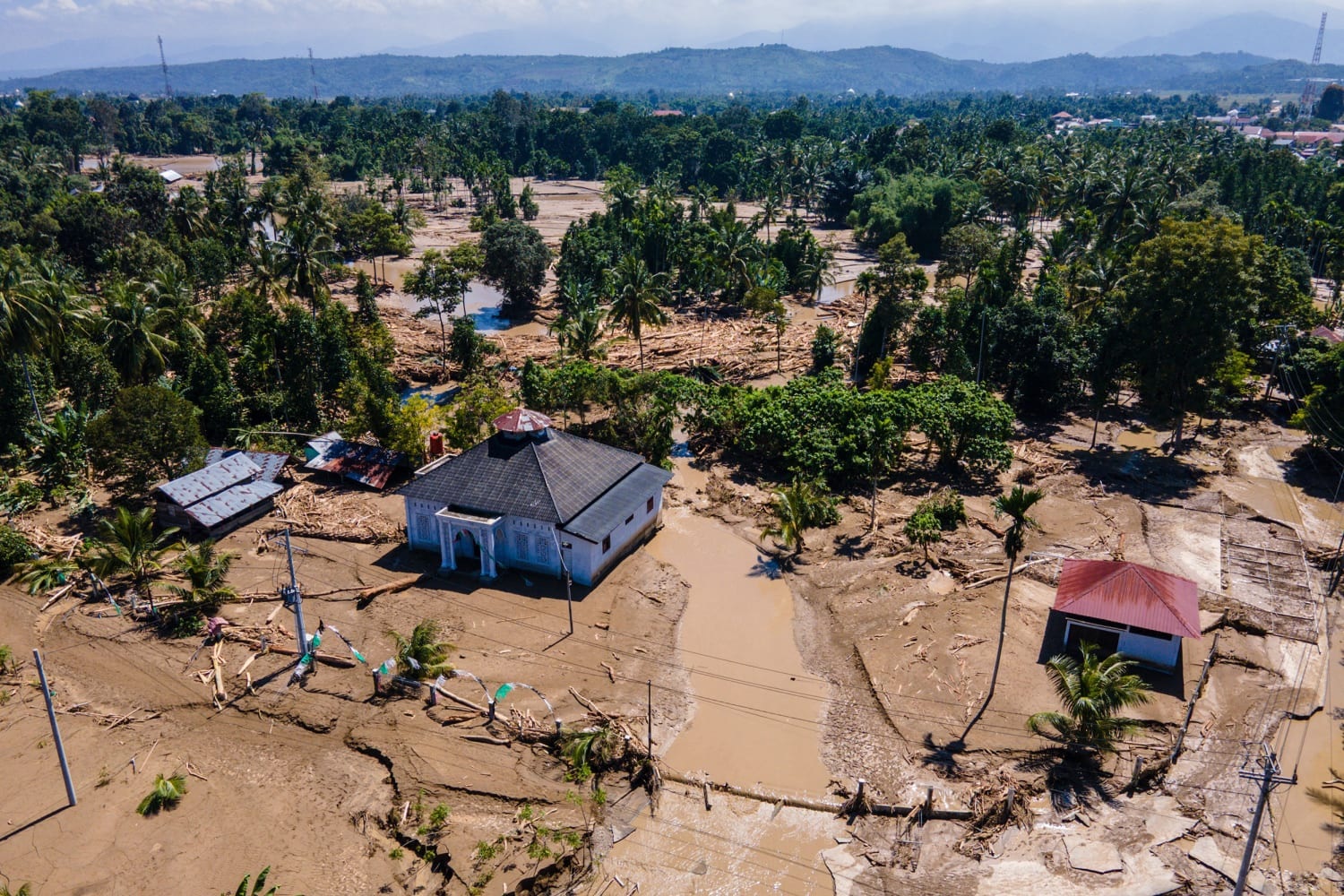
A house is seen buried in the mud at a village affected by flash flood in Pidie Jaya, Aceh province, Indonesia, Tuesday, Dec. 2, 2025. (AP Photo/Reza Saifullah)

Climate crisis adds fuel to local mismanagement

Scientists stress that deforestation alone did not cause the tragedy. The floods occurred amid an unusually intense rainy spell linked to broader climate patterns affecting Southeast Asia, including a rare tropical cyclone in nearby waters. Warmer oceans and shifting wind systems can load storms with more moisture, raising the chance of downpours that overwhelm even healthy landscapes. Yet experts also emphasise that intact forests act as a powerful buffer, slowing runoff, stabilising slopes and reducing the volume of debris that turns heavy rain into lethal mudslide.

In practical terms, that means climate adaptation and environmental protection cannot be treated as separate agendas. Indonesia has set ambitious targets to curb deforestation and reach net-zero emissions, but those goals are often discussed in the context of global climate diplomacy. The latest floods show a more immediate, local stakes: when forest cover disappears, it is nearby communities that pay the fastest and highest price. Aid workers say future recovery plans must include reforestation, river dredging and clear “no-build” zones on vulnerable slopes.

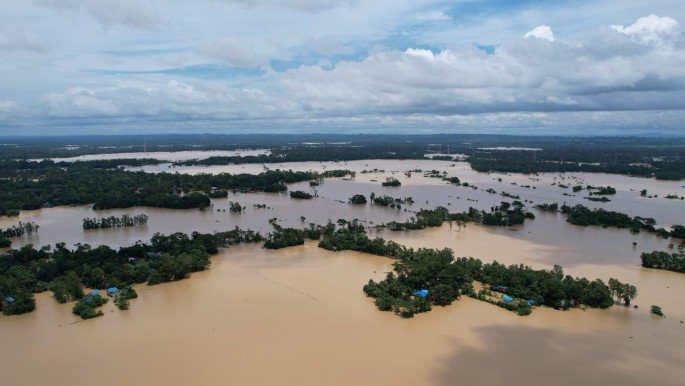
In this aerial photo taken using a drone, people are seen making their way on a muddy road at a village affected by a flash flood in Batang Toru, North Sumatra, Indonesia, Tuesday, Dec. 2, 2025. (AP Photo/Binsar Bakkara)

For farmers who survived, the challenge now is how to start again on land that has literally been reshaped. Fields are buried under metres of sludge; irrigation channels have vanished; and many livestock were swept away. Some residents question whether it is safe to rebuild in the same places at all. Others feel they have little choice, lacking money to move or buy new plots. Local planners face the politically sensitive task of redrawing village maps in a way that balances safety with cultural and economic ties to long-settled land.

Meanwhile, volunteers and local officials are working side by side to restore basic services. Bulldozers clear main roads while smaller teams dig by hand to reopen footpaths and uncover buried vehicles. Makeshift bridges of bamboo and planks are appearing over ravines where concrete structures once stood. In mosques and community halls, village elders are leading discussions about how to push for stronger enforcement against forest encroachment, so that grief and anger can translate into pressure for lasting change. Whether those voices are heard will go a long way toward determining if this disaster becomes a turning point, or simply another entry in a grim list.

A man looks at the damage caused by the floods at Gampola, Sri Lanka, Monday, Dec.1, 2025. (AP Photo/Eranga Jayawardena)

People look at a building damaged by the floods in Peradeniya, Sri Lanka, Monday, Dec. 1,2025. (AP Photo/Eranga Jayawardena)

05:55:56 pm, Tuesday, 2 December 2025

INDONESIANS BLAME ILLEGAL LOGGING AS FLOODS TURN VILLAGES INTO MUD FIELDS

05:55:56 pm, Tuesday, 2 December 2025

Deforested hillsides collapse after record rains

As rescue crews continue to search for survivors of Indonesia’s latest deadly floods, anger is rising in hard-hit communities over what locals call “mischievous hands” in the forests above their homes. Days of intense rainfall triggered flash floods and landslides that ripped through rural areas of West Sumatra, burying houses, roads and farmland under thick layers of mud and debris. Residents say they warned for years that uncontrolled logging and land clearing on steep slopes would end in tragedy. Now, with scores dead and many more missing, those warnings sound painfully prophetic.

In villages like Palembayan in Agam regency, satellite images and drone footage show bare, scarred hills where dense forest once absorbed heavy rains. Instead of soaking into soil and tree roots, runoff cascaded down exposed slopes, picking up rocks, felled trunks and pieces of homes in its path. Witnesses describe hearing a roar “like a jet engine” before a wall of water and mud swept away entire clusters of houses. For families who lost loved ones, the link between what happened upstream and the destruction downstream feels obvious, even if formal investigations will take months.

Men stand on logs swept away by flash flood in Batang Toru, North Sumatra, Indonesia, Tuesday, Dec. 2, 2025. (AP Photo/Binsar Bakkara)

Environmental groups have documented widespread encroachment into protected areas across parts of Sumatra. They accuse local officials of turning a blind eye as plantations, small-scale mines and illegal timber operations push ever higher into fragile terrain. In some cases, villagers say forests were replaced by shallow-rooted crops that offer little resistance when slopes become saturated. Indonesian disaster-management experts have repeatedly warned that such changes magnify the impact of extreme weather, but enforcement has often struggled against economic pressures and corruption.

The government has promised accountability. Senior ministers have visited the affected provinces and ordered a review of permits for logging and plantation concessions near disaster zones. Authorities say they will investigate whether companies or individuals violated land-use rules, and whether local agencies failed to act on early warning signs such as smaller landslides and blocked rivers. Critics argue that Indonesia has launched similar crackdowns after previous disasters, only for public attention to drift away once the headlines fade. This time, they say, real consequences must follow.

A house is seen buried in the mud at a village affected by flash flood in Pidie Jaya, Aceh province, Indonesia, Tuesday, Dec. 2, 2025. (AP Photo/Reza Saifullah)

Climate crisis adds fuel to local mismanagement

Scientists stress that deforestation alone did not cause the tragedy. The floods occurred amid an unusually intense rainy spell linked to broader climate patterns affecting Southeast Asia, including a rare tropical cyclone in nearby waters. Warmer oceans and shifting wind systems can load storms with more moisture, raising the chance of downpours that overwhelm even healthy landscapes. Yet experts also emphasise that intact forests act as a powerful buffer, slowing runoff, stabilising slopes and reducing the volume of debris that turns heavy rain into lethal mudslide.

In practical terms, that means climate adaptation and environmental protection cannot be treated as separate agendas. Indonesia has set ambitious targets to curb deforestation and reach net-zero emissions, but those goals are often discussed in the context of global climate diplomacy. The latest floods show a more immediate, local stakes: when forest cover disappears, it is nearby communities that pay the fastest and highest price. Aid workers say future recovery plans must include reforestation, river dredging and clear “no-build” zones on vulnerable slopes.

In this aerial photo taken using a drone, people are seen making their way on a muddy road at a village affected by a flash flood in Batang Toru, North Sumatra, Indonesia, Tuesday, Dec. 2, 2025. (AP Photo/Binsar Bakkara)

For farmers who survived, the challenge now is how to start again on land that has literally been reshaped. Fields are buried under metres of sludge; irrigation channels have vanished; and many livestock were swept away. Some residents question whether it is safe to rebuild in the same places at all. Others feel they have little choice, lacking money to move or buy new plots. Local planners face the politically sensitive task of redrawing village maps in a way that balances safety with cultural and economic ties to long-settled land.

Meanwhile, volunteers and local officials are working side by side to restore basic services. Bulldozers clear main roads while smaller teams dig by hand to reopen footpaths and uncover buried vehicles. Makeshift bridges of bamboo and planks are appearing over ravines where concrete structures once stood. In mosques and community halls, village elders are leading discussions about how to push for stronger enforcement against forest encroachment, so that grief and anger can translate into pressure for lasting change. Whether those voices are heard will go a long way toward determining if this disaster becomes a turning point, or simply another entry in a grim list.

A man looks at the damage caused by the floods at Gampola, Sri Lanka, Monday, Dec.1, 2025. (AP Photo/Eranga Jayawardena)

People look at a building damaged by the floods in Peradeniya, Sri Lanka, Monday, Dec. 1,2025. (AP Photo/Eranga Jayawardena)