11:21 pm, Saturday, 6 December 2025

Arc’teryx turns $1,000 jackets into China’s new status symbol

Sarakhon Report

Outdoor gear as quiet luxury in a slowing economy
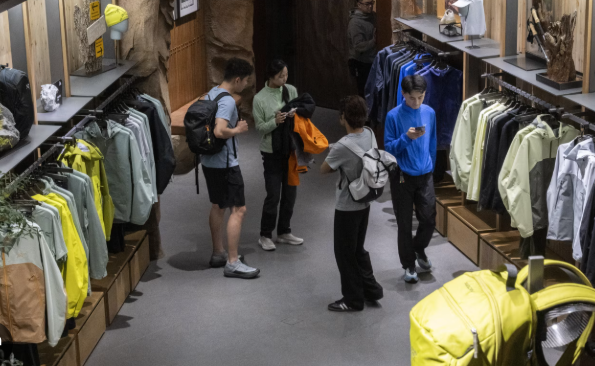
A new Wall Street Journal report shows how Canadian outdoor brand Arc’teryx has quietly become one of China’s most coveted labels, turning its $1,000 waterproof jackets into a status symbol for finance workers and style-conscious urbanites. The company’s flagship “museum” store on Shanghai’s West Nanjing Road now draws daily queues, its rocky interior walls mimicking British Columbia’s mountains while racks display high-end shells at prices often higher than in North America. As traditional luxury houses struggle with weaker sales, Arc’teryx has ridden a shift away from logo-heavy goods toward “high value” products that signal taste and technical quality rather than flash. According to the report, Greater China now accounts for nearly half of Arc’teryx’s revenue, up sharply from about a quarter just a few years ago, helping lift the brand’s global sales above $2 billion.

Owned by Amer Sports, itself controlled by China’s Anta Sports, Arc’teryx has refined its China strategy since 2019 by cutting wholesale dependence and focusing on direct-to-consumer stores in prime locations. That move has allowed tighter control over pricing and presentation, letting the brand cultivate an image that straddles performance and quiet luxury. The article notes that many Chinese customers wear Arc’teryx far more often in city streets than on actual mountainsides, pairing technical shells with office wear or casual outfits rather than climbing ropes and crampons. Even a recent controversy over an Arc’teryx-sponsored fireworks display on the Tibetan Plateau—which drew criticism over environmental damage and prompted an official investigation—failed to dent demand for long. After a brief slowdown, store traffic and sales rebounded as winter arrived and social-media outrage faded.

Arc'teryx Won Over China With a $1,000 Jacket. Now It's Popping Up Everywhere. - WSJ

Global expansion built on China playbook
Arc’teryx is now using lessons from China to drive expansion in other markets, including a new flagship in New York’s Rockefeller Center and a planned wave of additional stores by the decade’s end. Executives argue that positioning the brand as a “power uniform” for modern professionals—warm, technically advanced and instantly recognisable—opens doors well beyond the core outdoor community. The strategy hinges on maintaining premium pricing, technical credibility and carefully limited distribution, even as mainstream awareness grows. In practice, that means continuing to design gear around serious climbers and skiers while accepting that most buyers will wear it on commutes, coffee runs and weekend trips.

The brand’s rise also underlines how Chinese consumer culture is reshaping global retail. As property markets slump and economic uncertainty pushes wealthier shoppers to think more carefully about purchases, technical outerwear has become a quieter way to show status—expensive, but also functional. Arc’teryx’s success suggests that future luxury growth may come less from handbags and more from products that sit between fashion and equipment. For competitors, from Patagonia to European luxury houses dabbling in outdoor aesthetics, the message is clear: performance and authenticity now matter as much as logos. The path Arc’teryx has carved—from niche climber favourite to China-powered global symbol—shows how quickly a well-calibrated brand can move when cultural shifts and corporate strategy line up.

07:34:48 pm, Saturday, 6 December 2025

Arc’teryx turns $1,000 jackets into China’s new status symbol

07:34:48 pm, Saturday, 6 December 2025

Outdoor gear as quiet luxury in a slowing economy
A new Wall Street Journal report shows how Canadian outdoor brand Arc’teryx has quietly become one of China’s most coveted labels, turning its $1,000 waterproof jackets into a status symbol for finance workers and style-conscious urbanites. The company’s flagship “museum” store on Shanghai’s West Nanjing Road now draws daily queues, its rocky interior walls mimicking British Columbia’s mountains while racks display high-end shells at prices often higher than in North America. As traditional luxury houses struggle with weaker sales, Arc’teryx has ridden a shift away from logo-heavy goods toward “high value” products that signal taste and technical quality rather than flash. According to the report, Greater China now accounts for nearly half of Arc’teryx’s revenue, up sharply from about a quarter just a few years ago, helping lift the brand’s global sales above $2 billion.

Owned by Amer Sports, itself controlled by China’s Anta Sports, Arc’teryx has refined its China strategy since 2019 by cutting wholesale dependence and focusing on direct-to-consumer stores in prime locations. That move has allowed tighter control over pricing and presentation, letting the brand cultivate an image that straddles performance and quiet luxury. The article notes that many Chinese customers wear Arc’teryx far more often in city streets than on actual mountainsides, pairing technical shells with office wear or casual outfits rather than climbing ropes and crampons. Even a recent controversy over an Arc’teryx-sponsored fireworks display on the Tibetan Plateau—which drew criticism over environmental damage and prompted an official investigation—failed to dent demand for long. After a brief slowdown, store traffic and sales rebounded as winter arrived and social-media outrage faded.

Arc'teryx Won Over China With a $1,000 Jacket. Now It's Popping Up Everywhere. - WSJ

Global expansion built on China playbook
Arc’teryx is now using lessons from China to drive expansion in other markets, including a new flagship in New York’s Rockefeller Center and a planned wave of additional stores by the decade’s end. Executives argue that positioning the brand as a “power uniform” for modern professionals—warm, technically advanced and instantly recognisable—opens doors well beyond the core outdoor community. The strategy hinges on maintaining premium pricing, technical credibility and carefully limited distribution, even as mainstream awareness grows. In practice, that means continuing to design gear around serious climbers and skiers while accepting that most buyers will wear it on commutes, coffee runs and weekend trips.

The brand’s rise also underlines how Chinese consumer culture is reshaping global retail. As property markets slump and economic uncertainty pushes wealthier shoppers to think more carefully about purchases, technical outerwear has become a quieter way to show status—expensive, but also functional. Arc’teryx’s success suggests that future luxury growth may come less from handbags and more from products that sit between fashion and equipment. For competitors, from Patagonia to European luxury houses dabbling in outdoor aesthetics, the message is clear: performance and authenticity now matter as much as logos. The path Arc’teryx has carved—from niche climber favourite to China-powered global symbol—shows how quickly a well-calibrated brand can move when cultural shifts and corporate strategy line up.