12:53 am, Thursday, 26 March 2026

Hollywood’s Political Pulse: One Battle After Another Sweeps the 98th Oscars

Sarakhon Report

Warner Bros. dominates a history-making night

Paul Thomas Anderson’s political thriller One Battle After Another claimed six Academy Awards at the 98th Oscars ceremony on Sunday, including Best Picture, Best Director, and Best Adapted Screenplay. Anderson accepted the screenplay prize with a pointed dedication to the next generation. The evening capped a fierce season-long rivalry between two Warner Bros. titles that together redefined what mainstream cinema could attempt. One Battle After Another, a satire set in a police-state version of America, arrived in theatres as a bleak, high-stakes vision of radical politics, and it won over industry voters across nearly every major precursor award cycle. Anderson had swept the Critics Choice, Golden Globes, BAFTA, DGA, and PGA awards before Sunday’s ceremony, making his win widely anticipated but no less resonant. The film stars Leonardo DiCaprio, Teyana Taylor, Benicio del Toro, and Sean Penn.

Oscars 2026 Takeaways: 'One Battle After Another' Takes Top Honors - The New York Times

Penn makes history; a first-ever best actress Irish winner

Sean Penn took Best Supporting Actor for his portrayal of Colonel Steven J. Lockjaw, becoming only the fourth male performer to win three acting Oscars, joining Daniel Day-Lewis, Jack Nicholson, and Walter Brennan. Penn did not attend the ceremony. Presenter Kieran Culkin quipped from the stage that the actor either could not or simply chose not to be present. Penn has an openly complicated relationship with the awards establishment; reports circulated that he may have been travelling to Ukraine rather than attending. Jessie Buckley, playing a grieving mother in Chloé Zhao’s Hamnet, won Best Actress, becoming the first Irish woman to claim the top acting prize at the Oscars. Her victory had been projected well in advance after she won the BAFTA but confirmation on the night still drew a loud reception. Elsewhere, Sinners, Ryan Coogler’s blues-drenched vampire film set in the American South, won four awards including Best Actor for Michael B. Jordan and Best Cinematography for Autumn Durald Arkapaw, the first woman ever to take that prize. The evening also saw the Academy introduce its first new category in over two decades: Best Casting, won by Cassandra Kulukundis for her work on One Battle After Another. Warner Bros. releases claimed eleven prizes in total across the night, setting the stage for the studio’s pending $111 billion acquisition by David Ellison’s Paramount. Both One Battle After Another and Sinners were seen as validations of the studio’s willingness to back bold, expensive, and commercially risky projects.

05:04:41 pm, Tuesday, 17 March 2026

Hollywood’s Political Pulse: One Battle After Another Sweeps the 98th Oscars
05:04:41 pm, Tuesday, 17 March 2026

Warner Bros. dominates a history-making night

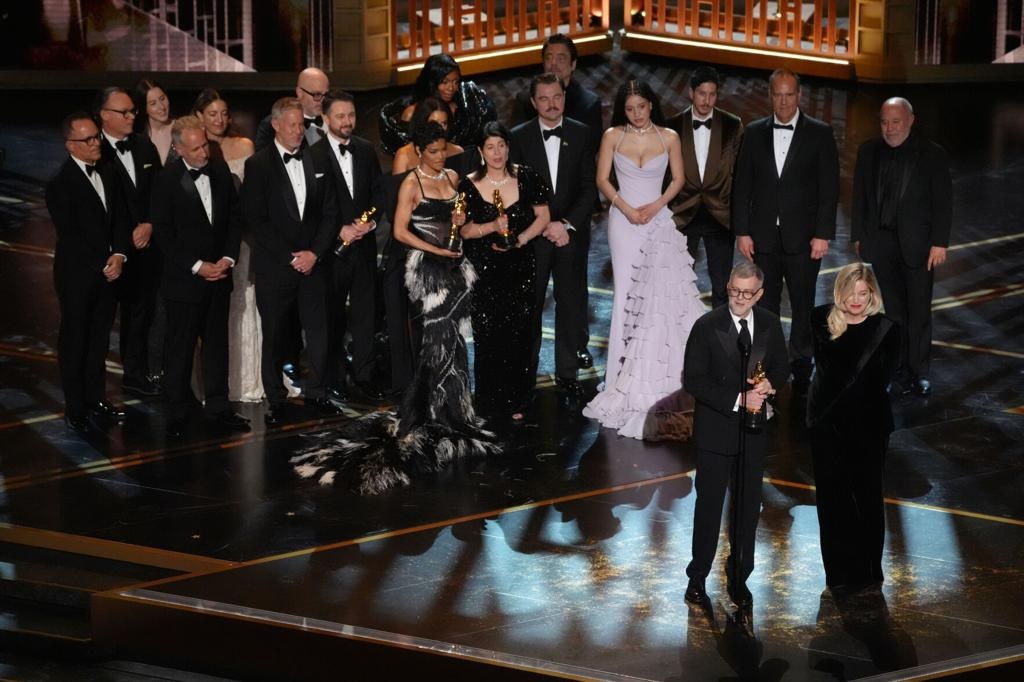
Paul Thomas Anderson’s political thriller One Battle After Another claimed six Academy Awards at the 98th Oscars ceremony on Sunday, including Best Picture, Best Director, and Best Adapted Screenplay. Anderson accepted the screenplay prize with a pointed dedication to the next generation. The evening capped a fierce season-long rivalry between two Warner Bros. titles that together redefined what mainstream cinema could attempt. One Battle After Another, a satire set in a police-state version of America, arrived in theatres as a bleak, high-stakes vision of radical politics, and it won over industry voters across nearly every major precursor award cycle. Anderson had swept the Critics Choice, Golden Globes, BAFTA, DGA, and PGA awards before Sunday’s ceremony, making his win widely anticipated but no less resonant. The film stars Leonardo DiCaprio, Teyana Taylor, Benicio del Toro, and Sean Penn.

Oscars 2026 Takeaways: 'One Battle After Another' Takes Top Honors - The New York Times

Penn makes history; a first-ever best actress Irish winner

Sean Penn took Best Supporting Actor for his portrayal of Colonel Steven J. Lockjaw, becoming only the fourth male performer to win three acting Oscars, joining Daniel Day-Lewis, Jack Nicholson, and Walter Brennan. Penn did not attend the ceremony. Presenter Kieran Culkin quipped from the stage that the actor either could not or simply chose not to be present. Penn has an openly complicated relationship with the awards establishment; reports circulated that he may have been travelling to Ukraine rather than attending. Jessie Buckley, playing a grieving mother in Chloé Zhao’s Hamnet, won Best Actress, becoming the first Irish woman to claim the top acting prize at the Oscars. Her victory had been projected well in advance after she won the BAFTA but confirmation on the night still drew a loud reception. Elsewhere, Sinners, Ryan Coogler’s blues-drenched vampire film set in the American South, won four awards including Best Actor for Michael B. Jordan and Best Cinematography for Autumn Durald Arkapaw, the first woman ever to take that prize. The evening also saw the Academy introduce its first new category in over two decades: Best Casting, won by Cassandra Kulukundis for her work on One Battle After Another. Warner Bros. releases claimed eleven prizes in total across the night, setting the stage for the studio’s pending $111 billion acquisition by David Ellison’s Paramount. Both One Battle After Another and Sinners were seen as validations of the studio’s willingness to back bold, expensive, and commercially risky projects.