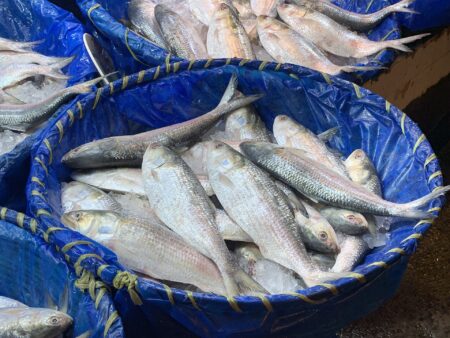


Hilsa production in Bangladesh has been declining for two consecutive fiscal years. According to data from the Department of Fisheries, hilsa catch dropped from a record 5 lakh 71,342 tonnes in the 2022-23 fiscal year to 5 lakh 288 tonnes in FY 2024-25. This represents a decrease of 71,054 tonnes, or about 12.4 percent, over the two-year period.
In the intervening 2023-24 fiscal year, production stood at 5 lakh 29,487 tonnes. The sharpest drop occurred in sea catches. In FY 2021-22, around 3 lakh 22,000 tonnes of hilsa were caught from the sea, which fell to about 2 lakh 51,000 tonnes in FY 2024-25. Over three years, marine hilsa catches dropped by nearly 71,000 tonnes, a decline of 22 percent.
The Minister of Fisheries and Livestock has acknowledged the decline in national hilsa production, stating that the government is aware of the situation. Accounts from coastal fishermen reflect the same reality. In Mohipur of Patuakhali, the number of fishing vessels going to sea was around 800 at most seven to eight years ago, but has now increased to nearly 1,500. Despite the increase in vessels, the catch has not grown, leaving many fishermen struggling to cover the costs of each trip.
Hilsa researcher and former director of the Fisheries Research Institute Anisur Rahman said that besides total production, the volume of large-sized hilsa has also decreased. According to him, reduced navigability along routes from the sea to rivers is disrupting hilsa migration. Surveys show that salinity at the Meghna estuary reaches nearly 10 ppt during the dry season, almost double the level recorded 10 years ago. Decreased freshwater flow in rivers increases salinity, which adversely affects hilsa breeding and movement.
Hilsa accounts for about 12 percent of Bangladesh’s total fish production, with the livelihoods of many people along coasts and riverbanks depending on it. Consequently, the drop in production is not just an issue of market prices, but of livelihoods. While some reports show slight variations in the 2024-25 fiscal year production estimates—citing 5 lakh 12,000 tonnes in some places and 5 lakh 4,000 tonnes in others—the downward trend remains clear across all figures.
More by Sarakhon Report
 Mohammedan and Abahani Suffer Defeats as Kings Win
 BFF Moves League Matches Out of Gopalganj Over Unrest
 Alif Paribahan Bus Set on Fire in Uttar Badda
 Selina Hossain’s ‘Japito Jibon’ Hits 20 Theaters