
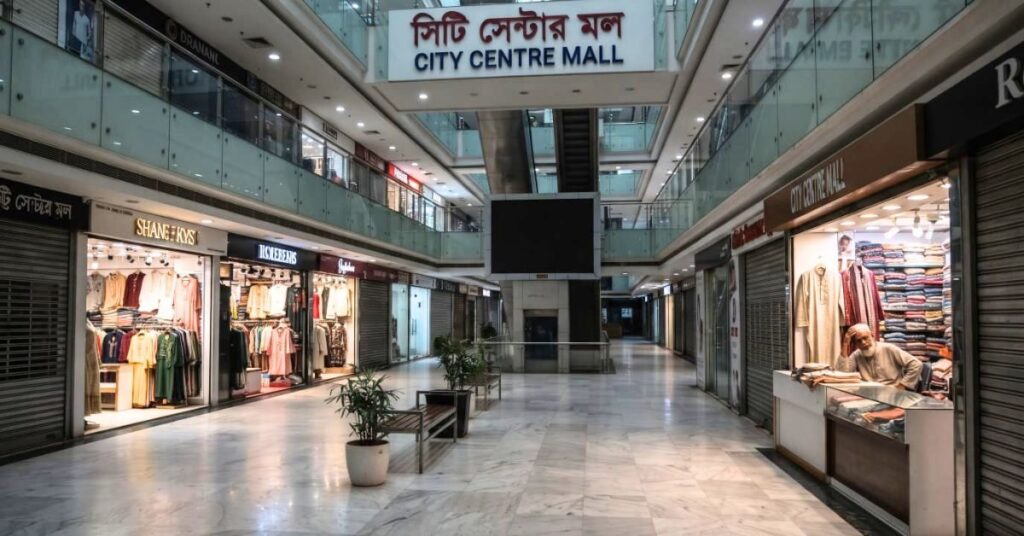
Karnaphuli Garden City Shopping Complex in the Kakrail-Shantinagar area of Dhaka was once a familiar shopping destination. Opened in 1998, the complex initially housed 198 shops. But after years of declining footfall, only 25 shops remained operational when it finally closed on October 1, 2026. Its owners are now considering changing the building’s use or selling it.
The decline of Karnaphuli Garden City is a major warning sign for Dhaka’s older shopping complexes. Businesspeople say at least 10 other ageing shopping centres in the capital face similar risks. Many shopkeepers go three to five consecutive days without making a sale. Their earnings are no longer enough to pay employees’ salaries, and some are having to dip into their capital just to keep their businesses running.
This is about more than the difficulties facing a handful of shopping centres. It points to broader concerns about Bangladesh’s consumer spending, the financial security of the middle class, employment, industrial production and the future of the retail sector. Falling customer numbers reflect both a decline in people’s disposable income and changing shopping habits. At the same time, shop rents, electricity bills, staff salaries and other operating costs continue to put pressure on businesses.
The Middle Class Still Has an Income, but Its Purchasing Power Is Shrinking
Understanding the difficulties facing shopping malls requires looking beyond gross domestic product (GDP) growth. It is also necessary to examine how much people earn, how much they spend on essential goods and services, and how much money remains for clothing, footwear, cosmetics, home furnishings and entertainment.
According to the Bangladesh Bureau of Statistics, general inflation stood at 8.34 per cent in September 2026. This means the average price level of goods and services was significantly higher than a year earlier. As a result, households can no longer buy as much as they once could with the same income.
Inflation has a particularly important effect on discretionary spending. When the cost of rice, lentils, fish, meat, medicine, rent, transport and electricity rises, households generally cut back first on non-essential purchases. They postpone buying new clothes, use their shoes for longer, spend less on cosmetics and home decoration, and limit their budgets for festival shopping. Middle- and lower-middle-income families account for a substantial share of the customers for these products.
In other words, fewer people visiting shopping malls does not necessarily mean they have lost interest in shopping. Their ability to afford it has also weakened.
How Deep Is the Middle Class’s Financial Vulnerability?
A 2025 study by the Power and Participation Research Centre (PPRC), based on 8,067 households, highlighted the financial vulnerability of a section of Bangladesh’s middle class. According to the organisation, around 18 per cent of the country’s population—approximately 31 million people—live in a precarious position. Although they remain above the poverty line, even a modest loss of income or increase in expenses could push them into financial hardship.
PPRC’s published figures show that an average middle-class household earns Tk 32,685 a month and spends Tk 32,615. That leaves an average monthly surplus of just Tk 70.
The significance of these figures is clear: a large section of the middle class has little money left for additional purchases. After meeting regular monthly expenses, opportunities to save or spend more are extremely limited.
The findings should not, however, be treated as a description of every middle-class household in Dhaka. They provide a national picture of household financial vulnerability. Nevertheless, they are relevant to understanding the retail market. When the gap between income and expenditure is almost zero, even a small increase in prices can reduce demand for clothing, footwear and cosmetics.
How Slower GDP Growth Affects Shopping Mall Businesses
In its Bangladesh economic update published on October 6, 2026, the World Bank forecast GDP growth of 3.4 per cent in both the current 2025–26 fiscal year and the following 2026–27 fiscal year. The organisation said weak investment, slowing export growth, high inflation and problems in the energy sector were putting pressure on economic activity and people’s purchasing power.
The International Monetary Fund’s (IMF) assessment published in January 2026 also pointed to a slowdown in Bangladesh’s economy. According to the organisation, GDP growth was 5.8 per cent in FY2022–23, 4.2 per cent in FY2023–24 and 3.7 per cent in FY2024–25.
Slower GDP growth does not necessarily mean that the country’s total output is falling. As long as growth remains positive, the economy is expanding, but at a slower pace than before. However, when that slowdown is accompanied by weak investment, fewer new jobs, stagnant real incomes and subdued consumer spending, retail businesses can feel the impact.
The effect on shopping malls typically unfolds in several stages.
First, lower business investment weakens the creation of new jobs and income. Second, when essential goods become more expensive without a corresponding rise in income, households cut discretionary spending. Third, as sales decline, shopkeepers reduce purchases of new stock, hiring and business expansion. Finally, falling revenue makes it harder for businesses to pay rent and meet other financial obligations.
In this way, weaknesses in the wider economy eventually become visible in the day-to-day operations of shopping centres.
However, it is not possible to calculate the exact percentage decline in Dhaka’s shopping mall sales directly from the GDP growth rate. That would require consistent data on retail sales, household consumption, individual shop revenues and the income and expenditure of shopping centres. The available figures indicate economic pressure, but GDP growth alone cannot establish the precise scale of the decline in mall sales.
Employment Pressures After the Fall of the Sheikh Hasina Government
Following the fall of the Sheikh Hasina government on August 5, 2024, uncertainty increased across Bangladesh’s business and industrial sectors. Problems surrounding the ownership and political affiliations of some businesses, factory closures, labour unrest, financing difficulties and shortages of export orders put pressure on employment. However, attributing all job losses solely to the political transition would not provide an accurate picture.
How Many People Lost Their Jobs?
A report published on January 27, 2025, quoted Amirul Haque Amin, president of the National Garment Workers Federation, as saying that around 70 factories had closed following the political change in August 2024, leaving approximately 100,000 workers and officials without jobs.
Labour-related statistics from the same period showed that 501 incidents were recorded in 2024 across 25 industrial and manufacturing sectors. These included layoffs, factory closures and labour protests over wage increases and unpaid salaries.
Another report, published on April 20, 2025, citing information from garment manufacturers and exporters, said 113 garment factories had closed between January 2024 and March 2025, resulting in more than 96,000 job losses. During the same period, 128 new factories opened, creating 74,081 jobs. According to these figures, the number of jobs lost through factory closures exceeded the number created by new factories by more than 22,000.
A further report published in December 2025, citing an internal government survey, said approximately 245 factories had closed between August 2024 and July 2025, affecting an estimated 100,000 workers. The same period also saw around 937 new factories open in Dhaka, Narayanganj, Narsingdi, Chattogram, Gazipur and Mymensingh.
These figures require careful interpretation. The three estimates cover different periods and are based on different sources. One relies on a labour leader’s statement, another on information from a garment industry association, and the third on a report about a government survey. They cannot simply be added together to produce a total number of job losses, as that could result in the same closures being counted more than once. Nor do these figures establish that everyone who lost a job because of a factory closure remained permanently unemployed.
Nevertheless, the available information points to a significant employment shock in parts of the industrial sector during the period following the political transition. Although new factories opened, job creation did not fully offset the losses in every case.
How Job Losses Affect Shopping Malls
When a garment worker or factory employee loses a job, the spending priorities of their household change. Without a regular income, families must first manage essential expenses such as food, rent, healthcare, education and loan repayments. Purchases of new clothes, shoes, cosmetics and other non-essential household items are likely to be postponed.
Similar effects can be felt among small business owners, transport workers, shop sales assistants, warehouse employees and people involved in supply chains. When their incomes fall, their spending also declines. This creates a link between employment conditions in the industrial sector and falling customer numbers at shopping malls.
There is, however, an important limitation: no consolidated statistics are available showing how many workers from closed factories live in Dhaka, what types of shops their families patronise, or how much retail sales have fallen as a direct result of job losses. Therefore, the figure of 100,000 job losses cannot be used as a direct measure of declining shopping mall sales.
The Impact of Factory Closures Extends Beyond Workers
When a factory shuts down, the consequences are not limited to its employees. Raw material suppliers, transport contractors, food vendors, small wholesalers, packaging companies, warehouses and service providers may also lose business. As the incomes of people working in these businesses decline, purchasing power in local markets weakens as well.
A report published on August 22, 2026, combining information from industrial police, garment industry organisations and other sources, said 457 industrial units had permanently closed in seven major industrial zones over two years. These included 108 garment factories, 35 knitwear units, eight textile factories and 19 establishments in export processing zones. The remaining 287 were non-garment manufacturing businesses.
Energy and electricity shortages, declining export orders, debt pressures and labour unrest were identified among the main reasons for the closures.
The figures indicate that the industrial crisis has multiple causes. Political instability is one factor, but energy supply, production costs, demand in international markets, debt repayment capacity and business management are also important.
For Dhaka’s shopping malls, this means that the income and job security of a section of potential customers are becoming less certain. At the same time, higher production and supply costs put additional pressure on shopkeepers. This combination of declining demand and rising business expenses can leave small and medium-sized shopping centres particularly vulnerable.
Online Shopping: A New Competitor for Traditional Malls
Another major factor behind the difficulties facing Dhaka’s shopping malls is the changing way people shop. In the past, visiting physical stores was the usual way to buy clothes, shoes, watches, cosmetics and gifts. Today, social media, online marketplaces and home delivery offer consumers new alternatives.
According to the Bangladesh Bureau of Statistics’ 2024–25 survey on the use of information and communication technology by households and individuals, 14.4 per cent of people in the country had purchased goods or services online. The figure was 21.3 per cent in Dhaka Division.
Clothing, footwear and sports goods were the most commonly purchased items online. Around 70.3 per cent of online shoppers reported buying products in this category. Food and groceries accounted for 34.6 per cent, while cosmetics accounted for 17.9 per cent.
These figures are particularly relevant to shopping malls because many of the most popular online purchases are products traditionally sold in clothing and cosmetics stores.
Why Does Online Shopping Offer an Advantage?
First, consumers can compare prices from multiple sellers without leaving home. Second, they can avoid transport costs, traffic congestion and parking difficulties. Third, many online sellers have lower overheads because they do not need to pay for conventional shop rentals and product displays, allowing some of them to offer lower prices. Fourth, social media enables small businesses to reach customers without maintaining large physical stores.
However, the growth of online shopping cannot be identified as the direct cause of shopping mall closures. The figure of 14.4 per cent represents the share of people who made online purchases; it does not represent online sales as a proportion of total retail sales. Therefore, this statistic cannot establish exactly how much shopping mall revenue has been lost to online businesses.
Demand for physical shopping also remains significant. In the same survey, 75.8 per cent of people who did not shop online said they preferred to see or touch products before buying them.
The future competition, therefore, is not simply between online platforms and physical stores. Shopping centres that can offer reliable products, fair prices, a pleasant environment and a convenient shopping experience are more likely to survive.
The Problem Is Not Just the Economic Slowdown: Older Malls Have Their Own Weaknesses
The closure of Karnaphuli Garden City shows why the difficulties facing shopping centres cannot be explained solely by the state of the national economy. A mall can lose customers over many years because of weak management, an inconvenient location, an unattractive environment or poor business decisions.
According to reports, the decline of Karnaphuli Garden City did not happen overnight. Several factors contributed to its loss of customers over nearly a decade. These included access difficulties during the construction of the Shantinagar Flyover, businesses moving to other markets, shops closing during the COVID-19 pandemic, and allegations that some sellers had marketed low-quality products as foreign goods. Competition from larger shopping malls and online businesses added to the pressure.
Several issues stand out.
Loss of customer confidence: If consumers fear they may be misled about a product’s quality, origin or price, they can move to other shops or markets. Once they become accustomed to shopping elsewhere, bringing them back can be difficult.
Transport and access problems: Even a good store can lose customers if reaching it is inconvenient. The decline in footfall at Karnaphuli Garden City during flyover construction illustrates this problem.
Lack of product variety: If a shopping centre does not offer a sufficient range of clothing, footwear, cosmetics, food and other essential products, customers may have to visit several locations. Larger malls often have an advantage in this respect.
Weak management: Cleanliness, security, lighting, air conditioning, parking and coordination among shops all influence the customer experience. Maintaining these facilities requires money. But when shops close, the funds available to maintain them also decline.
In other words, economic difficulties can make a struggling market even weaker, but each shopping centre also has its own history and internal challenges.
Rent, Electricity Bills and Salaries: Costs Remain High Even When Revenue Falls
One of the central weaknesses in the shopping mall business model is that many operating expenses remain unchanged even when customer numbers and sales decline. Shopkeepers may sell less, but rent, employee salaries, service charges and electricity bills do not necessarily fall. As profit margins shrink, businesses can eventually begin to incur losses.
Karnaphuli Garden City’s financial position provides a practical example. Its monthly operating expenses, including electricity bills and employee salaries, exceeded Tk 1.5 million. But its maximum monthly income from service charges was around Tk 100,000 to Tk 150,000. Representatives of the owners said unpaid electricity bills had exceeded Tk 5 million.
The scale of the problem becomes clear from a simple comparison.
Karnaphuli Garden City: Monthly Financial Picture
- Monthly operating expenses: More than Tk 1.5 million.
- Income from service charges: Tk 100,000–150,000.
- Estimated monthly shortfall: Tk 1.35–1.4 million or more.
This comparison is based on figures disclosed by the owners’ representatives. It is not a complete financial statement and does not include other income, outstanding liabilities or one-off expenses.
If such a deficit continues for a long time, owners must inject additional funds, borrow money or consider changing the building’s use. In Karnaphuli Garden City’s case, the owners eventually decided to close the complex and consider selling it.
Another problem is the cycle that develops when shops struggle to pay service charges. As sales fall, shopkeepers find it harder to meet those payments. Without service-charge revenue, mall management may struggle to pay electricity bills, maintain security and pay employees. Services then deteriorate, more customers leave and additional shops close. A shopping centre can become trapped in an increasingly damaging cycle of losses.
Earlier Closing Hours Add to the Pressure on Retailers
In August 2026, shops and shopping malls were instructed to close by 8pm as part of efforts to save energy. The decision placed additional pressure on businesses whose customers usually shop in the evening after finishing work.
According to businesspeople, bringing forward closing times affected sales that were already weak because of inflation. Some retailers reported that their sales had fallen by as much as 25 to 30 per cent during that period.
This is not a national statistical estimate showing that sales declined by the same rate at every shop. It is an estimate provided by businesspeople in specific sectors. Nevertheless, it highlights a relevant concern.
Middle-class salaried employees often shop after work. Earlier closing hours reduce the time available to them. Meanwhile, shopkeepers must continue to meet rent, salary and other fixed expenses despite operating for fewer hours.
However, the 2026 closing-time directive cannot be blamed for the closure of Karnaphuli Garden City alone. The decision to shut the complex came after years of declining customer numbers. The earlier closing hours should instead be viewed as an additional pressure on an already weakened retail market.
Which Shopping Centres in Dhaka Are at Risk?
Businesspeople say at least 10 other older shopping complexes in the capital are facing similar risks. Alongside the closure of Karnaphuli Garden City, several other centres have experienced declining customer numbers and sales.
These include:
Concord Twin Tower, Shantinagar: Sales have declined, but the management has said there are currently no plans to close the complex.
Molla Tower, Rampura: The shop owners’ association has identified it as one of the shopping centres facing business pressures.
Bishal Centre, Moghbazar: It is among the markets experiencing declining customer numbers and sales.
These centres should not be described as already closed. They face business risks, but no final decision has been announced about the future of all of them.
The key question is whether all shopping malls are experiencing the crisis in the same way. The answer is no. Large, popular and diversified shopping centres can offer customers a wider range of products, entertainment, food and other facilities. Older or smaller centres that lose customer confidence, product variety and convenient access are more likely to fall behind.
What Can Be Done to Overcome the Crisis?
The survival of Dhaka’s older shopping malls cannot depend solely on waiting for consumers’ incomes to rise. National economic recovery is important, but individual shopping centres must also address their own business weaknesses.
First, shop owners and mall management should jointly review operating costs. They need to identify ways to reduce expenses without compromising energy efficiency, security and essential services. If service-charge revenue falls because shops remain closed for long periods, alternative sources of income should also be considered.
Second, restoring customer confidence is essential. Businesses need greater transparency about product quality, origin, prices and after-sales services. Allegations that low-quality products are being sold as foreign or branded goods should be investigated and addressed.
Third, shops need to compete with online businesses while also exploring ways to work alongside them. Product displays on social media, online orders, in-store collection and home delivery could help traditional retailers reach new customers.
Fourth, shopping centres should diversify their products and services according to their location and customers’ needs. Instead of relying exclusively on clothing sales, they could consider a mix of food outlets, essential goods, services and businesses tailored to local demand—provided market research supports such a strategy.
Fifth, policymakers need to focus on creating jobs in industry and services, improving the investment climate, ensuring reliable energy supplies and easing inflationary pressure. Without stronger incomes and greater employment security, a sustained recovery in retail business will remain difficult.
The Shopping Mall Crisis Is Ultimately a Crisis of Purchasing Power and Business Models
There is no single reason behind the risk of shopping mall closures in Dhaka. Inflation and limited middle-class purchasing power, job losses in industry, slower economic growth, competition from online shopping, high operating costs and management weaknesses in older shopping centres have combined to create the current crisis.
The experience of Karnaphuli Garden City shows that even a once-familiar and popular shopping destination can become financially unviable after losing customers over many years. At the same time, weaker employment and incomes make it difficult to attract new customers. The crisis facing shopping centres and the financial difficulties facing households can therefore reinforce each other.
However, the available information does not establish that Dhaka’s shopping malls are closing solely because Bangladesh’s GDP growth has slowed, or that online shopping is the main cause of their decline. More specific data on sales, revenue, employment and household consumption would be needed to reach such conclusions.
What is clear is that building new shopping centres alone cannot ensure the health of the retail market. People need disposable income, employment security must improve, and older markets must adapt to changing consumer demands. Otherwise, a shopping centre that is losing customers today may eventually give way to a different business or use of the property.