
At Sheikh Hasina’s Side in Service to the Wounded: Fazle Hasan Abed


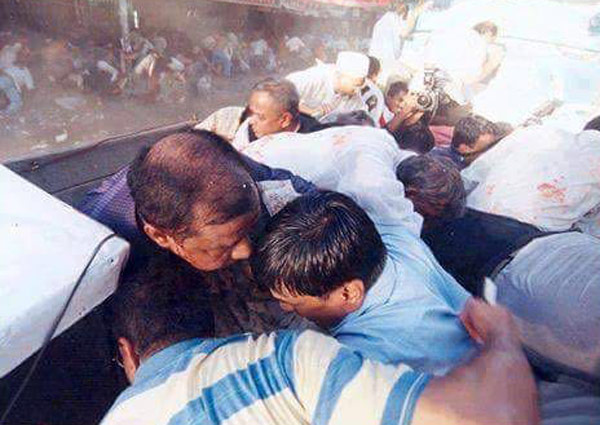
Returning home on 21 August 2004, it had already turned into 22 August by the time I arrived. It was well past one in the morning when I finally returned after finishing work at the office. As soon as I entered, Chitra told me that many people had called the house because they could not reach my mobile phone. They had not been able to find me at the office either.
I had been delayed in returning from work. I had told the telephone operator section at the office to say that I was not there if anyone called. The reason was that I had to finish two articles within roughly three hours.
Anyway, after looking at the list of those who had called, I mentally calculated that among them the only person likely to be awake at two in the morning was Ataus Samad bhai. So without even freshening up, I called him first.
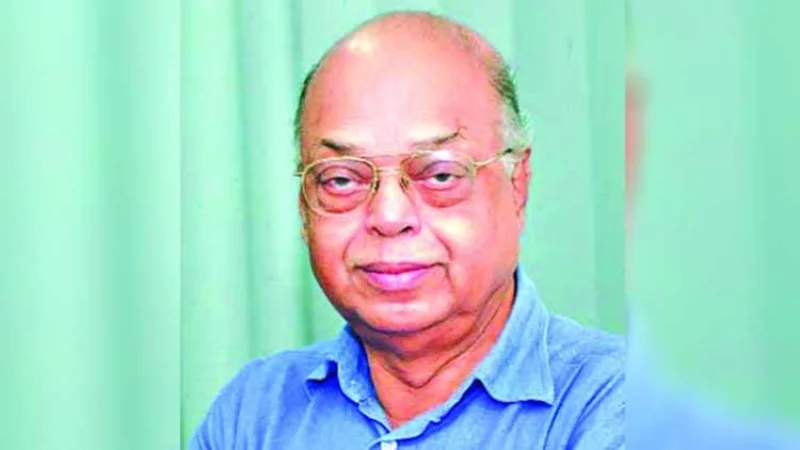
I found Samad bhai quite anxious. He carefully asked me how much of the day’s events I had personally witnessed with my own eyes and where exactly I had been present. After answering as best as I could, he said, “Look, I have Sheikh Hasina’s number, but I do not even have the number, or even the name, of the person who now performs the duties of her political assistant. Could you get in touch with her tomorrow morning and arrange a time for me? Many people will come tomorrow. I have no problem going there and sitting for some time, however long it takes.”
I replied, based on what we journalists had seen that day, that there would likely be a huge crowd there tomorrow as well. Would he really go in the middle of all that?
My remark irritated Ataus Samad bhai slightly. The irritation was not in his voice, but rather between the lines of his very polite words. He said:
“An attempt has been made to kill Sheikh Sahib’s daughter. By sheer fortune the lady has survived. Should I not go to see her because there will be a crowd? I should have gone tonight.”
Ataus Samad bhai and those of his earlier generation, meaning the generation of our fathers and uncles, used to address Bangabandhu as “Sheikh Sahib.” In reality, in this Bengal, that is to say today’s Bangladesh, there was a time when both the educated and the uneducated, the rich and the poor, would recognize two individuals simply by attaching the word “Sahib” to a single part of their name. One was “Huq Sahib,” meaning Sher-e-Bangla A. K. Fazlul Huq. And after him came “Sheikh Sahib,” meaning Bangabandhu Sheikh Mujibur Rahman.
Besides, Ataus Samad had also been connected, as a journalist, with many major events involving Bangabandhu. For example, in 1971, when the final hours of 25 March were passing and the clock was about to turn to 26 March, Bangabandhu escorted Tajuddin Ahmad, Dr. Kamal Hossain, and Barrister Amirul Islam to the veranda and asked them to leave. At that moment he noticed a shadow on the wall. When Bangabandhu moved toward it, Ataus Samad emerged.
Ataus Samad has spoken and written about the rest of the episode on various occasions. He had been standing pressed against the wall like that in the hope that after Bangabandhu’s meeting with Tajuddin Ahmad and Dr. Kamal Hossain ended, he might obtain a comment or perhaps an exclusive from him. But Bangabandhu quickly approached him and said, “Khokon” (Ataus Samad’s nickname), “do not remain here for another moment. Look over there, on the roof of the house next door and in the trees. They (the Pakistani army) have taken positions. If you try to leave from here later, they will shoot you. They may kill me as well.”
In the middle of Bangabandhu’s words, Ataus Samad tried to say something, beginning with “But you—”. Bangabandhu did not allow him to continue. Instead he said, “Leave immediately. And I have given you your independence. Now you must protect it.”
Ataus Samad bhai carried a certain pride regarding this incident. A few moments later Bangabandhu declared the independence of Bangladesh. The words of that independence were first heard from Bangabandhu’s own mouth by him, as a journalist. And through him that message reached the entire Bengali nation, that the responsibility of safeguarding that independence would belong to the people of the country through the ages.
However, that is another matter.
The next morning, after calling several times and finding the number of Sheikh Hasina’s political secretary busy, I decided it might be better simply to go there. I could arrange the appointment for Samad bhai in person, and perhaps also obtain some new information or news.
From where we sit in today’s Bangladesh, it is difficult to imagine that even after such a terrifying event, journalists and party leaders and activists could move in and out of Sheikh Hasina’s residence freely. There was no heavy army deployment, no strong police cordon, no RAB security.
I was going upstairs in search of Sheikh Hasina’s political secretary, Momtaz Hossien. As soon as I stepped onto the stairs, I saw M. R. Akhtar Mukul, famous for Chorompotro, and Kolim Sharafi, the distinguished theatre personality and Rabindra Sangeet artist, a close friend of Gan Natya’s Shambhu Mitra. Seeing me, Mukul bhai asked, “Have you received the real figures of the dead and injured? Is Ivy Rahman alive?”
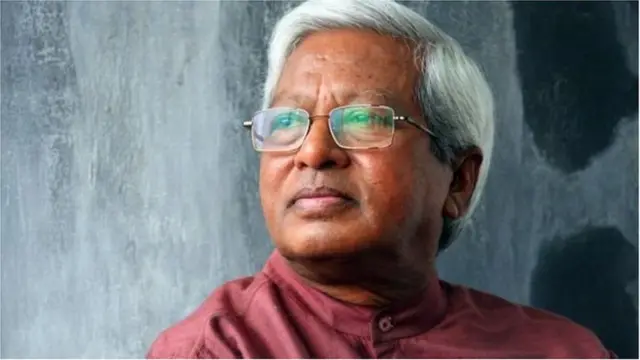
Without answering, I said, “Bhai, I will come to your Sagar Publishers office from my office in the afternoon.” As I stepped aside on the stairs, I saw Fazle Hasan Abed coming up. I made way for him to pass and followed behind him. When we reached the second floor, I saw Sheikh Hasina sitting somewhat better than she had been the day before. Two doctors were leaving. Dr. S. A. Malek was inside, seated. Several others were present. Sheikh Hasina’s political assistant was standing in the room. In the midst of all this, Fazle Hasan Abed went and sat on the sofa beside Sheikh Hasina.
Meanwhile Dr. S. A. Malek gestured to me with his hand. I hesitated for a moment, wondering whether I should enter or not. But when he beckoned again, I had to go in.
At that time I was not working as a full-time reporter. However, whenever I found time, I would move around searching for information for editorials or special pieces.
In any case, as soon as I entered that drawing room in Sudha Sadan, I saw Fazle Hasan Abed rising from the sofa. He was trying to place a bag beside it and was saying that he had come quickly. There was only twenty-five here, twenty-five lakh, he said. He would send more later.
Sheikh Hasina was trying to stop him. She was saying that there was no need. But Fazle Hasan Abed replied that she would now face many expenses. Many of her poor workers had been injured, and many families had lost their loved ones. Everyone would need help.
At that moment Sheikh Hasina’s political assistant Momtaz Hossien stepped out of the room. As soon as I approached him and mentioned arranging a time for Ataus Samad bhai, he immediately said, “Oh, Samad bhai,” and called Ataus Samad on the phone.
While he was making the call, I turned and saw Fazle Hasan Abed going downstairs.
It was entirely natural for Fazle Hasan Abed to act this way. His lineage, his heritage, his commitment to the Liberation War of 1971, all of these together made such humanity and courtesy entirely natural for him.
Yet at that moment, as a journalist, a question occurred to me. After this assassination attempt on Sheikh Hasina, the former prime minister of the country, the leader of the opposition, and above all the daughter of Bangabandhu, did the country’s other major NGO leader, Dr. Yunus, come to express sympathy to Sheikh Hasina? After all, while in power Sheikh Hasina had granted him a highly profitable business such as Grameen Phone.
For several weeks I regularly asked various people around that house. I came to know that he had not come. Much later I asked Matia Chowdhury whether, in casual conversation, she might learn from Sheikh Hasina whether Dr. Yunus had at least called her to express sympathy.
Matia Chowdhury asked me in return why I was curious about this. I told her the truth. While reporting the 1991 election in different parts of the country, I had seen instructions being sent to employees of Grameen Bank not to vote for the Awami League’s boat symbol.
Matia Chowdhury then laughed and replied that she had also had the same question. And she had asked her leader, Sheikh Hasina. The answer she had received was that Dr. Yunus had not called.
Author: Journalist and editor honored with the highest state award, Editor of Sarakhon and The Present World.