
Swadesh Roy
Hindu society had, at one time, become a stagnant pool. Both Rammohan Roy and Ishwar Chandra Vidyasagar uprooted the poisonous trees of superstition that had taken root in those stagnant waters.
Broadly speaking, Rammohan Roy brought an end to the practice of burning Hindu widows alive on their husbands’ funeral pyres. Ishwar Chandra Vidyasagar introduced widow remarriage into Hindu society. Everyone knows that they uprooted these two terrible poisonous trees from Hindu society. Beyond this, their other major contribution, one that belonged not to any particular religion but to every Bengali, was their work in education and language.
The language in which Bengalis today can readily express their thoughts and feelings was shaped by the touch of Rabindranath, Pramatha Chowdhury, Suniti Kumar Chatterjee, the writers of the Kallol era, Rajshekhar Basu, and Syed Mujtaba Ali. Behind it stand these two towering figures: Raja Rammohan Roy and Ishwar Chandra Vidyasagar.
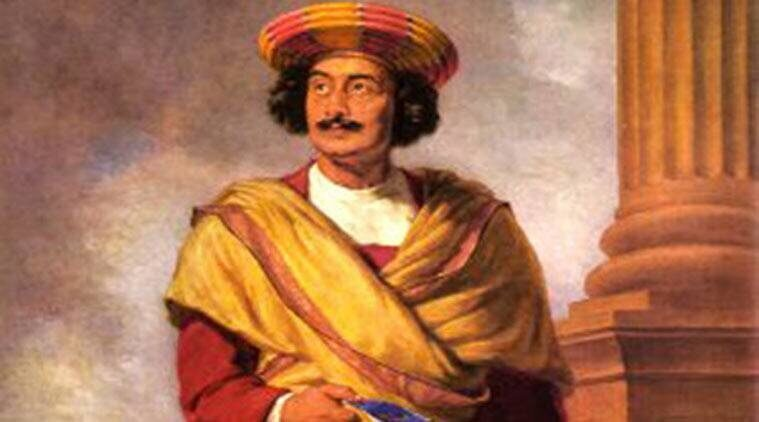
Yet Raja Rammohan was not only India’s pathfinder; he was also the first thinker on this subcontinent to conceive of a liberal state. Likewise, he laid the foundation for modern women’s standing and identity in their own right.
The Brahmo Samaj he founded has been the subject of much controversy within Hindu society. Most Hindus hurled the word “Bemmo” at him as an insult. Even so, if we trace the roots, we find that not only in Calcutta but also in East Bengal, today’s Bangladesh, the beginnings of women’s education, marriage for women at a mature age, and the opening of a way out of the abyss into which Hindu society had been plunged by confining women, half its population, within the home under the shackles of the rules of the Manusmriti, or Manusamhita, came about, directly or indirectly, chiefly through the influence of Rammohan’s Brahmo Samaj.
The women of families that had become Brahmo were already further ahead in education and social emancipation, and their example indirectly influenced many Hindu families in the upper reaches of society. And in the Brahmo Samaj’s era of Maharshi Debendranath Tagore, Keshab Chandra Sen, Shibnath Shastri, and Bijoy Goswami, that influence extended to wealthy and upper-middle-class Hindu households. More significant than the reform it brought to religion was the work it accomplished in women’s education.
As a result, highly educated young men gradually moved away from marrying girls aged seven to ten who had not even learned the alphabet. Society, following their lead, also began to move away from the practice. And indirectly, this influence reached Bengali Muslim society as well.
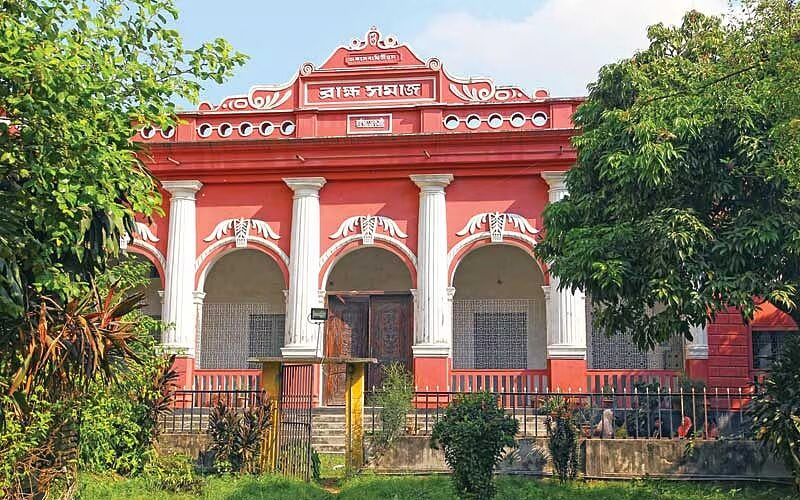
East Bengal was by no means behind in this respect. In his book The Brahmo Movement in Nineteenth-Century East Bengal, Muntassir Mamoon mentions Dinanath Sen and East Bengal of His Time, a book about Dinanath Sen written by his son Adinath. In addition, in the early 1980s, at that Brahmo Samaj library, I read a small book titled The Brahmo Samaj of East Bengal, which had survived the fire of 1971, though it lacked the author’s name and several pages at both the beginning and the end. In 1987 or 1988, Mofidul Bhai (Mofidul Hoque) gave me another small book, titled The Brahmo Samaj of Dhaka, to read while I was preparing a cover story on the Brahmo Samaj for Sandhani.
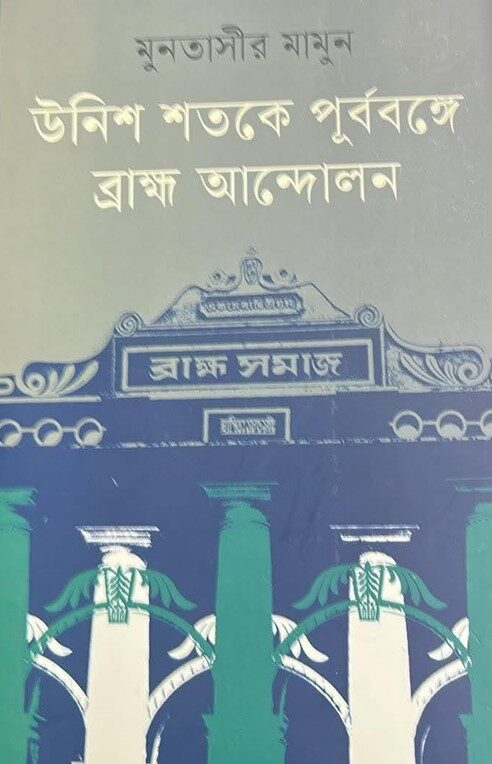
First published in 2017, with a revised second edition subsequently published in 2026, The Brahmo Movement in Nineteenth-Century East Bengal is a royal-size volume of nearly 800 pages, written by Muntassir Mamoon and published by Ananya. It is a work of historical significance. Professor Muntassir Mamoon gave it to me towards the end of 2025. That is, after the first few printed copies had reached the author. The book had not yet been released on the market.
This is not the place for an extended discussion of that book. But after reading this work by Muntassir Mamoon, I found factual substantiation for a truth I had observed since childhood. From my childhood, I had seen that Bengali families which had been highly educated and free of restrictive social prejudices from much earlier times either had connections with the Brahmos or had someone in the family who had joined the Brahmo Samaj.
My homeland is East Bengal, today’s Bangladesh. I have been visiting the main centre of the Brahmo Samaj in Dhaka since the 1970s. But how just a handful of people spread this movement across East Bengal is something I hope to write about another day, drawing on Muntassir Mamoon’s book.
I am, however, grateful to Muntassir Mamoon for answering a longstanding question in this book. Whenever I meet friends from different parts of India, or come to know people through work, there is one thing I always say: look, do not equate the Bengalis of East Bengal, or today’s Bangladesh, with the Bengalis of West Bengal. The Bengalis of the riverine landscape of East Bengal, or today’s Bangladesh, are different. Although I could recognise that they were different, I had not found the precise reason why. A quotation from Shibnath Shastri on page 127 of Muntassir Mamoon’s research volume will help open everyone’s eyes to the people of Bangladesh. Explaining why the Brahmo Samaj spread in East Bengal despite the obstacles, Shibnath Shastri writes: “There is no frivolity in the people of East Bengal. Whatever they do, they will do with their very lives; whatever they take up, they will hold to with their very lives: this is the spirit of East Bengal. Without this spirit, a country cannot rise, nor can national life blossom anew.”
From Shibnath Shastri’s nineteenth-century understanding of the people of East Bengal, today’s Bangladesh, I can understand why, soon after the creation of that strange state called Pakistan, the people of East Bengal were so quick to lay down their lives to uphold the dignity of the Bengali language, and so quick to embrace Bengali culture and Bengali nationalism with such wholehearted devotion. And it was from this steadfast conviction, “Whatever we do, we shall do with our very lives,” that they not only carried Bengali nationalism forward but also created a state for the Bengali people and developed that state.
A foreign conspiracy, carried out through a “meticulous design” under the leadership of the foreign conspirators’ collaborator Yunus, has sought to destroy Bangladesh and the Bengali nation. Much damage has indeed been done. But the steadfast Bengali people have shaken off the blows and risen like a lion. From a rickshaw puller to an ordinary mother or sister in a village, the language in which people express their hatred of Yunus is not merely fire; it is an explosive charge. On the other hand, eighty per cent of the people of Bangladesh have once again embraced Bengali culture and Bengali nationalism with all their hearts and souls.
This has once again demonstrated that the character of the people of East Bengal shares that same steadfastness of Rammohan. He was the first Indian to tell the British: every citizen shall enjoy the same freedom that you enjoy as the ruler of the state. No ruler of any state has the right to curtail the freedom of any individual or group.
And today, on the 193rd anniversary of Rammohan’s death, another issue has come before Hindu society. One hundred and ninety-two years after his death, India’s Congress leader Rahul Gandhi called for the reform or removal of the third injunction of the ninth chapter of the Manusamhita, which is still observed in many aspects of Hindu religious practice concerning women.
The third injunction of the ninth chapter of the Manusamhita states:
Pitā rakṣati kaumāre bhartā rakṣati yauvane. Rakṣanti sthavire putrā na strī svātantryam arhati.
(A woman is protected by her father in maidenhood, by her husband in youth, and by her sons in old age. A woman is not worthy of independence. Translation : Suresh Chandra Bandyopadhyay.)
Texts such as the Manusamhita have always been devised to hold one group or another captive in the interests of a king or the state. And across the world, books laying down such injunctions to keep women captive are particularly numerous. For the history of civilisation shows that women are more dedicated in everything from warfare to running households and governing states. Men have therefore repeatedly sought, in their own interests, to hold women captive under various names and guises.
This captivity does not exist among the wealthy and upper-middle-class sections of Hindu society. But among ordinary people, these injunctions still instil fear. Rahul Gandhi has said that women should not be known solely as someone’s mother, wife, or daughter; women should be recognised as leaders of states, entrepreneurs, and military strategists, and, indeed, for their own individual capabilities.
One hundred and ninety-two years after Rammohan’s death, this advance in thought and this call for change truly express genuine respect for him. Yet every Bengali would have been happy if a Bengali had stood with conviction and spoken these words.
Author: A journalist honoured with the highest state award; Editor, Sarakhon and The Present World.
More by Swadesh Roy
 Is the Ganges Water Treaty Heading Towards a December Deadlock?Can “People-to-People” Diplomacy Exist Where More Than Half the People Are Invisible?
 The Day Bangladesh’s Founding Father Was Desecrated
 Tarique Rahman’s First Visit to India: Bangladesh Can at Least Hope for the Teesta Agreement