

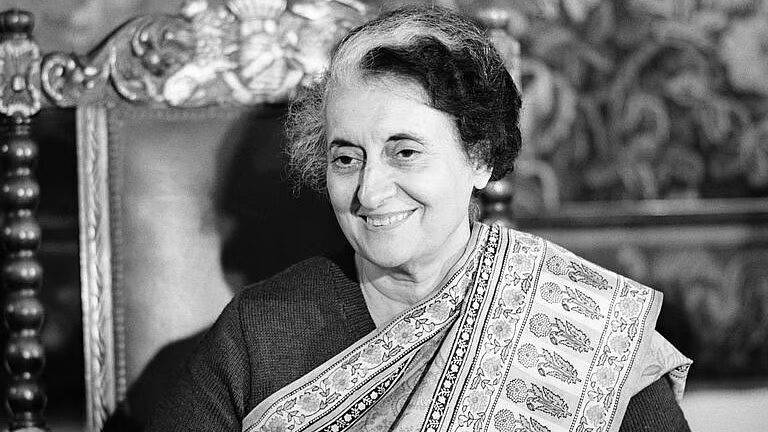
Durga Puja in 1971 also fell in October. I do not know exactly how the Hindus who remained in this prison camp called Bangladesh observed the Puja that year. But as I walked through the refugee camps in India, I would see idols of Durga being made at many Puja pavilions nearby. The artists’ skilful work certainly held my gaze, but what drew my eyes even more was a photograph of Indira Gandhi, whenever I came across one in a shop selling calendars and pictures, or somewhere by the roadside.
The goddess Durga is, in reality, the likeness of a village woman from the age of agrarian civilisation, managing a household in her husband’s home. A woman who needs ten hands to keep that household running. Bengalis have invested her with divinity and made her a goddess, yet they have also kept her within their own courtyards as a cherished daughter of the household and as a mother. This is what distinguishes the Bengali. Above all, the Bengali spirit is sahajiya, instinctively drawn to an unforced, deeply human way of life. Religion sometimes constrains that spirit, whichever religion it may be. But Bengalis cannot be held for very long by the taut ropes of rigid religion. They return to their own way of living, to the realities of their own lives.
In the reality of the refugee camps in 1971, Indira Gandhi was far more necessary, far more real, than the goddess Durga. It was her photograph that appealed to me then. There was not even time to wonder whether Durga could actually slay demons. Rather, whenever I saw a photograph of Indira Gandhi, my heart somehow filled with fresh hope; I felt that she would soon go to war to liberate the Bengalis.
It was not merely the great power, America; in that sense, no country really helped Bangladesh’s liberation struggle. Yet people across the world, from America onwards, and even a section of the people of Pakistan, supported the Bengalis’ liberation. And as the leader of all these people, Indira Gandhi had emerged as Bangladesh’s liberator. This found expression in the artist Husain’s painting, in which the map of Bangladesh emerges from Indira Gandhi’s womb.
In reality, human need comes first. It is out of need that the sun, the sky, the sea, even the great serpents of the sea, have all become gods. This Puja, we have moved from the prison camp created by Yunus into Yunus 2. Thousands of Border Guard Bangladesh personnel have been deployed for this year’s Puja. Jamaat and BNP workers are standing guard over the Puja pavilions.
Writing about this year’s Puja, a man named Debashish Ranjan Sarkar posted on his Facebook page: “Apparently, that Puja is being held in Banani again, with a park rented as it is every year. Extensive advertising. But tell me, is any actual worship taking place at the Puja?”
There are many comments beneath this post. In one of them, Subarna Barma writes: “At one pavilion, I hear, they are playing ‘Bangladesh First, Bangladesh My Last’ to the beat of the dhak.” It should be mentioned that, whether or not “Bangladesh First, Bangladesh My Last” is grammatically correct, it is the BNP’s unofficial party anthem.
Replying to Subarna Barma’s comment, Debashish Ranjan Sarkar writes: “Subarna Barma, whatever happens to be in season, you know. All the temples are dens of party loyalists anyway.”
Before the Puja, of course, BNP leader Ruhul Kabir Rizvi had announced that leaders of the BNP and its affiliated organisations would keep all the temples under strict guard.
Political workers have not enjoyed a particularly good reputation for a long time as it is. Besides, if those whom people have seen presenting themselves as political workers in Bangladesh since 5 August 2024 really are political workers, then “mob gang member” and “extortionist” would have to be synonyms for “political worker”. And when they are the ones assigned to guard the temples, little is left to the imagination about the circumstances in which our mothers and sisters must offer their prayers and worship.
Beneath Debashish Ranjan Sarkar’s Facebook post, a man named Sudeb Som comments: “In almost every temple, the Puja has turned into a farce. The swagger of the motherboard (I could not quite understand what this word meant) Sanatani religious leaders and the ruling and opposition parties’ enforcers fills one with disgust. Without having purified themselves, these newly minted leaders come and sit right up against the Brahmin priest while the worship is in progress.”
Even if I had not understood that this year’s Puja would turn out this way, those who move about in different places had understood it beforehand. The young man who gives me physiotherapy, for instance, graduated about ten years ago with very high marks from CRP, Bangladesh’s best physiotherapy college. He turned down an offer of a teaching position and works independently. His home is in Jessore. Jessore and Nadia were close neighbours. Naturally, therefore, he is a Vaishnava, a devotee of Sri Krishna. But then, this is what happens in this alluvial land of East Bengal: just as Buddhists here eat plenty of fish, his family, despite their devotion to Krishna, duly observes both Kali Puja and Durga Puja, worshipping the goddess in her manifestations of divine power.
This year, I found him arriving on the morning of Mahalaya to give me physiotherapy. I thought that times had changed, that Mahalaya no longer carried its former importance. But I was surprised to see him on the morning of Panchami. I could not help asking, “What, aren’t you celebrating Puja?”
In a flat, detached voice, he said, “Oh, sir, Puja. Is Puja anything like it used to be?” In the way he said “used to be”, I heard the same note of despair that I hear when rickshaw pullers, vegetable sellers, CNG drivers and pavement fruit sellers, people I speak to almost every day, say, “Sir, we were better off before.” It brought back the first period of despair in my own life, when, in the refugee camps, a photograph of Indira Gandhi pleased me more and gave me greater hope than an idol of Durga. Perhaps this year, they too see the true Durga in another image rather than in a picture of the goddess. After all, who can say which image will become the ten-armed one, or when?
Then, as he continued giving me therapy, he said, “Sir, I have read in several of your articles about the Durga Puja that used to be held at your family home. But that was not the Durga of this akal bodhan, the invocation outside the customary season; it was Basanti, the Durga of spring. Basanti Puja comes after December, doesn’t it?”
Seeing that his remarks were heading in a different direction, I quickly changed the subject. “Look,” I said, “I was a student at the Ramakrishna Mission, and there the principal form of Durga is Jagaddhatri. Perhaps our ancestors thought of Basanti in much the same way.”
No, even steering the conversation elsewhere did not stop him. He said to me directly, “Sir, what would have happened if we had suspended the Puja for just one year? Is there any meaning in celebrating this Puja while Chinmoy Prabhu remains in prison?”
Trying to reason with him, I said very softly, “Look, ordinary people will have a little joy during the Puja. Politics should not be brought into that.” His answer was, “It is the Hindu leaders who are playing politics. Because India has supported the BNP, they have barely mentioned Chinmoy Prabhu’s case and gone straight into celebrating Puja. These Hindu leaders have homes in India. Sir, we did not go to India even in 1971. We stayed here.”
I kept sighing, trying to discourage him from continuing. And I found myself recalling how, several months earlier at the health club, Mati bhai, the editor of Prothom Alo, had suddenly asked me, “Will India stick to this policy to the very end?” Smiling, I replied, “You have more contact with them than I do. You would be better placed to say.”
Even so, he wanted to hear my opinion. I said, “I have no access to information about India’s policy. But they have gained something from the fall of Sheikh Hasina’s government. For instance, whoever was responsible for it, the ‘Dipu Das’ incident could not have been brought about with Sheikh Hasina in power. And the Dipu Das incident benefited the BJP in the West Bengal election. Besides, there was the removal of so many Muslim voters’ names through the SIR process there before the election. Had Sheikh Hasina been in power, the clerics would have held a demonstration at the north gate of Baitul Mukarram. With Tarique Rahman in power, that did not happen.” Mati bhai changed the subject.
A lawyer and singer who was sitting beside me at the health club then asked, “Dada, how heavily do you think the Hindus voted for the BNP this time?” I am a great admirer of the gentleman’s rich, resonant voice. So there is a different kind of bond between us. I told him, “Look, Ramesh Chandra Sen of Thakurgaon was an honest politician. You and I both know about his arrest and his unnatural death. Even after all that, Hindu leaders went to his bereaved family to recommend that they vote for the BNP.” The gentleman asked, “Why did that happen?”
Smiling, I said, “Historically, India is a friendly country to us. So, for historical reasons, it has friends here. And even where history is not the reason, self-interest ensures that countries like ours have agents working for many foreign countries. When a country chooses to use its agents and when it chooses to seek advice from its friends is its own business. But the reality is that G. M. Quader has set out calculations showing that no more than 12 to 14 per cent of voters went to the polling stations this time. Neither you nor I was ever bad at arithmetic. We can read Bengali, too. So, after reading what G. M. Quader has written, we can extend his calculations a little and work it out for ourselves: Hindus make up 7.89 per cent of the total population. Therefore, if the total turnout was 12 to 14 per cent, how many votes could have been cast from that 7.89 per cent?” The gentleman took me by the hand, drew me over to the jacuzzi and, sitting down, began to sing in his full, resonant voice: “Mother, when your face grows sorrowful, my eyes… O Mother, my eyes overflow with tears.” Then, with the faint trace of a wan smile on both our lips, we sank together into a deep silence.
As I silently recalled these conversations at the health club several months earlier while receiving physiotherapy, the young physiotherapist broke the silence again. “Sir, won’t they release Chinmoy Prabhu?”
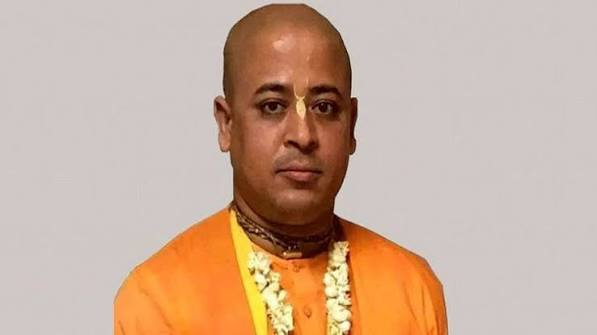
The young man is so innocent. How do I explain to him that, in this world, no one grants anyone else freedom? Whoever seeks freedom must win it for themselves. And Chinmoy has chosen a difficult path. One on which there is no fleeing. Since 1947, the entire philosophy of life for Bangladesh’s Hindus has been one of flight. But between 2009 and 2024, successive groups of young people grew up in Bangladesh as citizens of equal standing, rather than as a minority. Besides, as information technology opened up the world, they also learned to understand that every country has religious minorities. But if the state and the party governing it are secular, their minority identity no longer defines their standing as citizens. They can find their place according to their abilities.
Of course, some older members of minority communities in Bangladesh took advantage of this period and made many mistakes. But the younger members of these communities learned to love their own country. Yes, for this, both they and the secular government had to endure some additional criticism. There were accusations of minority appeasement. Propaganda claiming that Hindus had taken over every sphere was also circulated.
This happens when secular forces are in power. When the Baath Party was in power in Iraq, and when Assad was in power in Syria, there were claims that Christians were being given greater advantages or being appeased. In reality, putting secularism into practice always requires a measure of deliberate partiality towards minorities. Because of the inhumanity of some of those around them, certain members of minority communities in every country become somewhat fearful. It falls to a secular state, or to secular individuals, to give them a little additional confidence and help them break out of that confinement of fear. The politician Professor Muzaffar Ahmad explained this more clearly than anyone.
In any case, that courageous young generation has emerged among Bangladesh’s minorities. These are young people who believe in Nazrul, with his words inscribed deep within their consciousness as a source of courage: “Let no one be afraid at the sight of clouds; behind them, the sun is smiling.” And Chinmoy Prabhu is leading these young people. Keeping him behind bars has therefore imprisoned the entire Puja, something no opportunists have been able to prevent. This is the truth, and this is the victory of love for one’s country.
The tradition of akal bodhan, the invocation of Durga outside the customary season, is said to be more than five thousand years old. And if such an invocation can be made once, it can be made again and again. Let there be another akal bodhan, then, one morning with Chinmoy free and surrounded by the new generation.
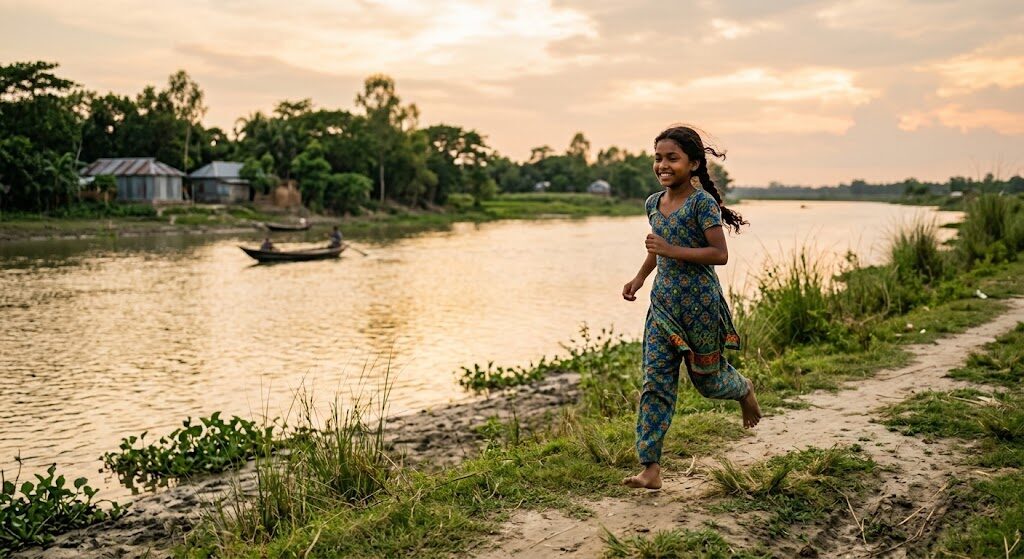
Durga is, after all, a girl from our own village. She grew up running along the riverbank and across the open fields, and one day became the ten-armed goddess. She is not merely the wielder of the trident that slays demons; in that trident, she also holds the power to dispel ignorance and establish peace.
Author: A journalist honoured with the country’s highest state award; Editor, Sarakhon and The Present World.
More by Swadesh Roy
 Rammohan and Women’s Emancipation: East Bengal’s Brahmo Samaj and Rahul GandhiIs the Ganges Water Treaty Heading Towards a December Deadlock?Can “People-to-People” Diplomacy Exist Where More Than Half the People Are Invisible?
 The Day Bangladesh’s Founding Father Was Desecrated