
From a peasant’s home in France came Joan of Arc; from a peasant’s home in Bengal came Nuruldin. Why does a Joan of Arc emerge in France, and why does a Nuruldin emerge in Bengal? History does not offer the deepest answer to this question. It brings the whole setting into view, and we have to search for the answer within it.
But a poet is a poet, and so he brings the answer to us in just a few lines. In Bangladesh’s post-Tagore verse drama, no one comes close to Syed Shamsul Haque. Through Nuruldin, he shows in just a few lines when and how, in age after age, people rise up for progress and freedom in village after village, in the paddy fields and in the humble huts. Those lines are like the storytelling voices of grandmothers, which could conjure images of demons and ogres before a child’s eyes in an instant.
Syed Shamsul Haque brings into sharp focus the moment when the conditions arise for a Nuruldin or a Joan of Arc to emerge from an ordinary peasant. In a few simple words, he paints as clear a picture as the grandmothers telling their tales:
“And I can bear this oppression no more.
And I can bear this hunger no more.
And I can bear this injustice no more.
And I can bear sitting here no more.”
When oppression crosses all bounds, the final jolt comes to the person in that humble hut, in that field of withered crops, that hunger-stricken, starving human being: “I can bear sitting here no more.” In other words, no more sitting idle.
We did not see Nuruldin’s struggle. But we did see the Liberation War of 1971. There, the greatest thing of all was this: “I can bear this oppression no more,” and, in response, “I can bear sitting here no more.” In reality, no matter how powerful the oppressors were that day, ordinary people could no longer sit idle. Syed Mujtaba Ali’s two lines of poetry tell us how people rose up and came out instead of sitting still:
“The Liberation War has called. How can you stay at home?
Bind your very life with your gamchha, and take it with you.”
From what we learn by reading history, it seems that people take their lives in their hands and march out to fight for freedom from oppression. But a poet sees the depth of the strength people summon to struggle against oppression before giving up their lives. And how immense that strength is. They will have to fight with both hands. They will not stop to carry their life in one hand, so the peasant calls on them to bind it with a gamchha and take it along. It is as if, just as tying a gamchha around the waist gathers strength, life itself is being turned into strength. And when people turn their lives into strength and rise against oppression, each one becomes a Nuruldin.
That is why, in Syed Shamsul Haque’s verse drama The Lifelong Journey of Nuruldin, the Blue Chorus, which he brings in as a counter-voice, says:
“Your leader Nuruldin isn’t even in Pangsā.
…
Your leader Nuruldin isn’t in Patgram, either.
…
Your leader Nuruldin isn’t even in Dimla.”
The Red Chorus replies:
“He is, he is, he is.
Our leader Nuruldin is here throughout the land.
Our leader Nuruldin is here throughout the land.”
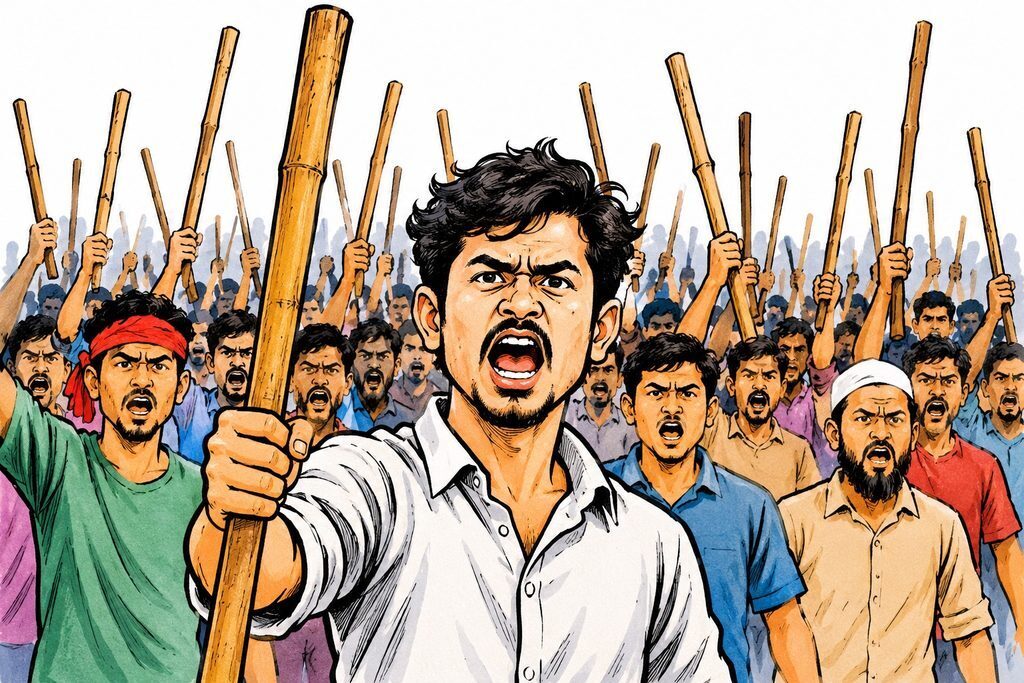
By putting the words “throughout the land” into the Red Chorus’s mouth twice, the poet tells us that Nuruldin is not found only in Patgram, Pangsā, or Dimla. Wherever the need arises, a Nuruldin has been born. If, through these words of the Red Chorus, we look back at the Liberation War we witnessed in Bangladesh’s history, they open our eyes to what really happened. On that day, against oppression, the very best students, the ones whose home was their study table, rose up. So did a wild, spirited boy from a village, someone nobody had known in that way. Somehow, they came out against oppression; as they joined the ranks, each became a Nuruldin in his own region before he even realized it. That is the reality: throughout the country, people become Nuruldin in the face of oppression. And Nuruldin cannot be killed off.
“We may die, but life itself does not die.
If one Nuruldin goes away,
a thousand Nuruldins will come to Bengal.
If one Nuruldin is lost,
myriads of Nuruldins will appear,
countless Nuruldins will live on.”
And here lies the greatest strength in the struggle against oppression. The body of one Nuruldin dies, but the being called Nuruldin, the spirit that rises against oppression, cannot be killed. On the contrary, when one person is killed and oppression intensifies, myriads upon myriads of Nuruldins are born.
In the words of Nuruldin, the hero of The Lifelong Journey of Nuruldin:
“From the earth, the body is born again.”
And because Nuruldin is born again and again from this earth, because myriads upon myriads of Nuruldins are born when one Nuruldin is killed, the poet’s pen calmly gives us this truth through Nuruldin’s voice: an oppressor’s time never lasts long.
That is why Nuruldin says:
“It goes.
It changes.
The day changes.
The times change.
The moon changes there.
The clouds change there.
The current of the Teesta changes.
The marks of people walking
across the grass change.
People change, too.
People’s thoughts change, too.”
In reality, the history of the world says time and again that bad days never last forever. Corrupt or wicked ideas never last forever. Ordinary people, each becoming a Nuruldin, change them. Perhaps blood is shed; perhaps a sister is violated. Many tears may flow down the Teesta and the Jamuna. Still, people change things.
We repeatedly search history for the reason the people of Bangladesh have always been able to change the dark chapters of their history so quickly. But the poet Syed Shamsul Haque, through the Nuruldin he created, says:
“In the south of our land lies the Bay of Bengal;
may the human voice roar like it.”
Perhaps that is why no one has heard a leader’s voice roar like the Bay of Bengal except a Bengali leader.
Why do we see Nuruldins’ struggles so often in the pages of history? Why are Nuruldins born again and again throughout the country? Why do we keep remembering Nuruldin? The poet Syed Shamsul Haque gives us two lines that show when people bring Nuruldin within themselves:
“Field in ruin, ground in ruin, river in ruin, seed utterly ruined,
when the whole society lies in ruin.”
It is as if, in just fourteen words, he has written one epic within a verse drama, an epic almost as vast as the whole Mahabharata. When a community’s or a state’s field is ruined, its capacity to create is being destroyed; when its ground is ruined, the spaces where creation can take place are being destroyed; when its river is ruined, the flow of clear thought, of thought that moves forward, is being destroyed; and when its seed is ruined, its own children are being destroyed. Then no path remains to save that community or state except through Nuruldin. If we look closely, can we not find the essence of the entire epic called the Mahabharata in these fourteen words?
And when does every Bengali remember Nuruldin in this Bengal?
In the current of the poet Syed Shamsul Haque’s words, we hear:
“When vultures descend upon this golden Bengal;
I remember Nuruldin.
When my country is covered by the cloaks of collaborators;
I remember Nuruldin.
When my dreams are looted;
I remember Nuruldin.
When my voice is confiscated and taken away;
I remember Nuruldin.
When, in my own country, blood
flows from my body
across every page of history.”
Author: Journalist awarded with Bangladesh’s highest state honor; editor of Sarakhon and The Present World.
More by Swadesh Roy
 Remembering Indira Gandhi, Defending Secularism in BangladeshDeny Bangabandhu Sheikh Mujibur Rahman, and Bangladesh becomes a ‘Mini Pakistan’
 Leaders and Activists Born of Adversity and the Words “No One Has the Power to Hang Sheikh Hasina”
 In 1971, Not Durga but Indira Gandhi; Chinmoy in Prison and Durga, the Village Girl