11:45 pm, Tuesday, 16 June 2026

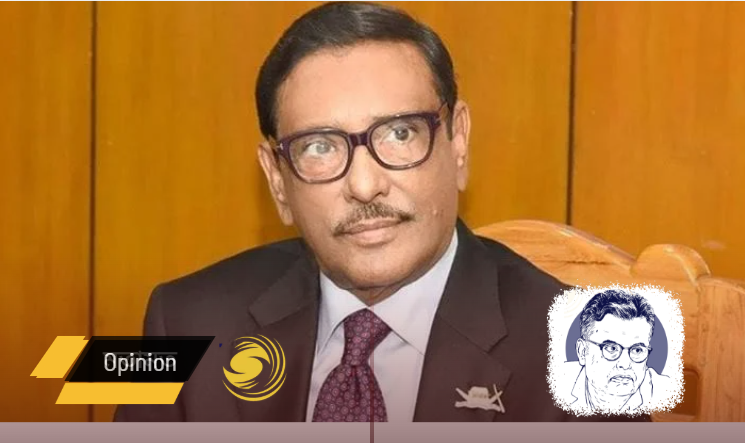
Obaidul Quader: The Wrong Man for the Awami League’s Most Historic Post

Swadesh Roy

Obaidul Quader became president of the Chhatra League while he was in jail. Those who were involved in Chhatra League politics at that time under the Awami League, Malek-Razzaq, all knew that Obaidul Quader became president of the Chhatra League after instructions came from a particular center of power to the Awami League leaders of that period, Abdul Malek Ukil and Abdur Razzaq. Both Abdul Malek Ukil and Abdur Razzaq listened to that particular center of power.

Everyone knows what Malek Ukil publicly said after the death of Bangabandhu Sheikh Mujibur Rahman. And what he said on 15 August 1975, after the Friday prayers, in the house in Tikatuli, where he had taken shelter, I will not mention here. On the other hand, how Abdur Razzaq first went with Mostaq after 15 August, then went with Ziaur Rahman, and how, through contact with Obaidur Rahman, he entered jail and politics, is another chapter altogether.

For this reason, after 15 August 1975, when the Chhatra League’s position in student politics was gradually becoming stronger, selecting Obaidul Quader as president was a correct decision for those in power.

Many presidents of the Chhatra League did not remain, or has not remained, continuously in Awami League politics. With the changes in Bangladesh’s political landscape, they too changed their colours. Even Sheikh Shahid, the nephew of Bangabandhu Sheikh Mujibur Rahman, did so. Besides, a person’s political beliefs can change. And because of a change in belief, or because of convenience, one may change parties. That is entirely a personal matter. But Obaidul Quader is the only one who, while remaining in Awami League politics, wrote and said that “Bangladeshi nationalism” too was correct.

Many people think, or it is often said, that the original inventors of “Bangladeshi nationalism” were Khandaker Abdul Hamid and Abul Mansur Ahmad. In reality, these two brought the idea onto people’s lips. But it was first uttered by Basanta Chatterjee. Basanta Chatterjee and Nirad C. Chaudhuri came from the same place. Strangely, their belief was also the same, that to be Bengali meant to be Bengali Hindu. For this reason, Basanta Chatterjee stated that if Bangladesh came into being, the nationalism of Bangladesh would be “Bangladeshi.” The real purpose behind this was to suggest that the Muslim population of the territory of Bangladesh could in no way be the bearer of Bengali culture.

In other words, a division was created in an extremely subtle manner. The deeper purpose of this division lay even further beneath the surface. Because the Bengali language- and territory-based nationalism that developed through the movements of the fifties and sixties became not only clear but also defined through the mass uprising of 1969. For example, “Tumi ke, ami ke, Bangali, Bangali”, who are you, who am I, Bengali, Bengali. That is, rising above religion, caste and clan, everyone is Bengali. And that territory was identified through the slogan, “Tomar amar thikana, Padma, Meghna, Jamuna”, your address and mine, Padma, Meghna, Jamuna. That is why the national flag during the Liberation War also carried the map of Bangladesh, washed by the Padma, Meghna and Jamuna.

Therefore, those who struck, or strike, at this Bengali nationalism are, in essence, striking subtly at the very foundation of Bangladesh and trying to push Bangladesh toward becoming a mini-Pakistan. Because India and Pakistan were created on the basis of religion. Only Bangladesh was created by the Bengalis of this territory under Bangabandhu’s leadership on the basis of culture-based nationalism, where there was no connection between the state and religion.

Therefore, the fact that Obaidul Quader, while remaining within Awami League politics, supported Bangladeshi nationalism in writing is truly mysterious. Besides this, everyone will remember that during the last Awami League tenure, after the Awami League came to power through the 2008 election, Obaidul Quader was not made a minister at first. During this period, Obaidul Quader would often attack two successful and educated individuals of the Awami League government through statements and interviews in newspapers or while speaking at public programs. These two were Abul Maal Abdul Muhith, the distinguished writer, intellectual and Bangladesh’s most successful finance minister, and Hossain Toufique Imam, the personality who gave structural shape to the activities of the Awami League, then the Prime Minister’s adviser, better known as H. T. Imam.

Why Obaidul Quader attacked these two when there were so many ministers and advisers is mysterious. Because through the 2008 election, the Awami League came to power while carrying the burden of an economic recession. At that time, the greatest challenge was to confront the economic downturn and move the country’s economy forward. For this reason, from the very beginning, Finance Minister Abul Maal Abdul Muhith tried on one hand to rebuild good relations with international financial institutions, and on the other hand, placed emphasis on the domestic market. At that time, Bangladesh’s relations with international financial institutions had deteriorated to such a level that, after World Bank funds given to the City Corporation for the greening of Dhaka were almost entirely consumed by corruption, the World Bank stopped allocations even for such small projects. At such a time, in order to move the economy forward amid recession, what was needed most was a stable administration. H. T. Imam, rising above party lines, quickly built a stable administration with everyone, almost in the spirit of reconciliation. As a result, good relations were quickly established with international financial institutions, and even amid recession, the country’s economy gained momentum. But at that time, it was seen that Obaidul Quader, along with a person responsible for a key financial institution, was continuously attacking these two individuals. And the forces that wanted distance between the government and international financial institutions quickly succeeded through them.

After this, Obaidul Quader was made a minister in order to silence him. The other person, naturally or through his own negligence, was punished and lost his post. But even after becoming a minister, Obaidul Quader did not move away from this work. He continued to do the work of that special force. For example, while delivering a speech at a Chhatra League meeting at TSC, H. T. Imam told the Chhatra League students: study and pass the written BCS examination. “So that you can pass the viva, if necessary, I myself will coach you. And I will also arrange coaching through many other experienced people.”

That day, the media reported that H. T. Imam had said, I will make arrangements so that Chhatra League boys can pass the viva. And so that the news would go out in this form, Obaidul Quader also phoned a few reporters close to him. In other words, they were a circle. And the report was broadcast in that manner by most television channels and newspapers. Later, Abdul Gaffar Chowdhury wrote about the actual truth of the matter.

In reality, future researchers of this country will have to research which group inside the inner chambers of politics was behind this work.

Even after all this, Obaidul Quader became the General Secretary of the Bangladesh Awami League. Leaders such as Shamsul Haque, Bangabandhu Sheikh Mujibur Rahman, Tajuddin Ahmad, Zillur Rahman, Syeda Sajeda Chowdhury, Abdul Jalil and Syed Ashraf had held this post. Among them, from Shamsul Haque and Bangabandhu to Syed Ashraf, the Awami League, Bangladesh and Bengali nationalism were one inseparable entity. But recently, because of some so-called writers and researchers, I have seen on social media an attempt to turn Tajuddin Ahmad into a kind of communist in the eyes of young people who stand for Bengali nationalism. Although this is not the subject of this article, one line must be said. Tajuddin Ahmad’s student life, his life as special assistant to Chief Minister Ataur Rahman Khan, then his long and gradual political life including as president of the Greater Dhaka District Awami League, and finally as Prime Minister during the Liberation War, all speak for themselves. The young people who are tagging him as leftist are making a mistake. As for the rest, I do not know what their purpose is. But Bangabandhu and Tajuddin Ahmad were both true revolutionaries. Revolutionaries carry a large part of revolution within their own lives. In order to change themselves, Bangabandhu and Tajuddin Ahmad both adopted into their own lives the sacrifice and discipline they saw in the lives of the communists of their youth. And during the Liberation War, it was Tajuddin Ahmad who remained most conscious that arms should not go into the hands of the “special leftists.” If that happened, they would take the Liberation War in a different direction.

Therefore, there had not been such bankruptcy within the Awami League that Obaidul Quader had to be made General Secretary in a post once held by such personalities. And after he became General Secretary, everyone knows how the activities of this organisation were destroyed, and how all its affiliated organisations were destroyed. I do not want to increase the length of this article by explaining how Obaidul Quader carried out that work. Besides, any true worker of the Awami League organisation can write or speak about this matter much better than I can. I will only say one line: from Shamsul Haque and Bangabandhu to Syed Ashraf, all of them were “brothers” to the leaders and workers. Obaidul Quader was “Sir.”

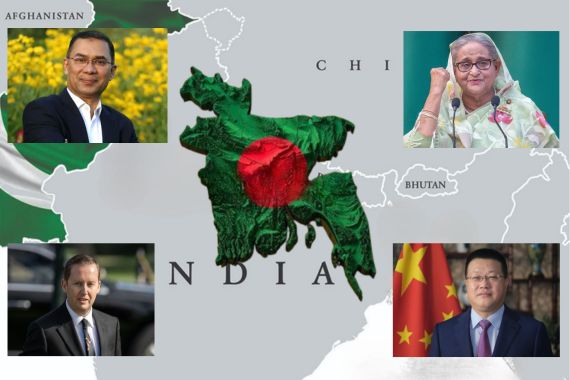
Recently, I saw on social media that this “Sir” of the Awami League was telling their party leader, “Apa, you had almost reached the stature of a statesman.” Even after the success of such a meticulous design to turn Sheikh Hasina into a fascist, the development of Bangladesh and Sheikh Hasina remain almost synonymous. And one thing is now on the lips of ordinary people: “We were better off before.” Above all, ordinary people also say that after Jaishankar came to Bangladesh, everything in Bangladesh’s politics changed. If Sheikh Hasina had simply accepted it, if she had not tried to move forward by taking all countries along with her, then her fall would not have happened. Not only that, people can see that now it is the ambassadors who are triumphant everywhere. And during Sheikh Hasina’s time, so many ministers came and returned without even getting to meet the Prime Minister. Even after all this, Obaidul Quader says, “You had almost reached the stature of a statesman.”

At one point in that statement, what Obaidul Quader said reveals, even if from some distance, that making the current President, Mohammed Shahabuddin, President was a major mistake by Sheikh Hasina.

As a journalist, I know that Obaidul Quader himself wanted to go to that post. For that reason, he may well have a grievance against Shahabuddin. But what is more important is that in that statement he said, “What has the President given us?” After Yunus’s meticulous design succeeded, what President Shahabuddin gave Bangladesh while standing at the mouth of death in that Bangladesh, the environment to write that has not yet arrived. But if that environment ever returns, at least this much will be written there: defying death, the President performed his duty. And amid Yunus’s dreadful conspiracy and vengeance, he kept the country’s Constitution alive. There was no deficiency in his commitment there.

However, only this can be said to Obaidul Quader. He is the General Secretary of the party. The party president, Sheikh Hasina, did not flee. She left the country with state honour in an aircraft of the Bangladesh Army. In the words of the current Jamaat leader and freedom fighter Major Akhtaruzzaman, she retreated from the war. A successful retreat is also a very great victory in the science of war.

But why did Obaidul Quader flee while being the party’s General Secretary? And why did he tell his workers the story of hiding in a bathroom? What was the purpose? Amir Hossain Amu, at the age of 85, could have left long before him; he did not. He did not tell his workers any story about hiding in a bathroom. Rather, standing in court, he said, “The condition you are seeing today will not remain tomorrow.” This is the truth of politics. Politics, like the current of a river, rises upward and then comes down again. This is its natural motion.

But Obaidul Quader did not practise politics. Like people of the Mamata Banerjee and Shamim Osman brand, he played a “game.” As General Secretary of the Awami League, while holding the very post once held by Bangabandhu, he would say, like Mamata or Shamim Osman, “Khela hobe”, the game will be played. Tofail Ahmed stood in Parliament and said, this is not the language of politics. Even after that, he continued to use that language. A person who does not have the language of politics in his mouth, who is he?

Writer: Journalist awarded the highest state honour; Editor, Sarakhon, The Present World.

09:00:15 pm, Tuesday, 16 June 2026

Obaidul Quader: The Wrong Man for the Awami League’s Most Historic Post

09:00:15 pm, Tuesday, 16 June 2026

Obaidul Quader became president of the Chhatra League while he was in jail. Those who were involved in Chhatra League politics at that time under the Awami League, Malek-Razzaq, all knew that Obaidul Quader became president of the Chhatra League after instructions came from a particular center of power to the Awami League leaders of that period, Abdul Malek Ukil and Abdur Razzaq. Both Abdul Malek Ukil and Abdur Razzaq listened to that particular center of power.

Everyone knows what Malek Ukil publicly said after the death of Bangabandhu Sheikh Mujibur Rahman. And what he said on 15 August 1975, after the Friday prayers, in the house in Tikatuli, where he had taken shelter, I will not mention here. On the other hand, how Abdur Razzaq first went with Mostaq after 15 August, then went with Ziaur Rahman, and how, through contact with Obaidur Rahman, he entered jail and politics, is another chapter altogether.

For this reason, after 15 August 1975, when the Chhatra League’s position in student politics was gradually becoming stronger, selecting Obaidul Quader as president was a correct decision for those in power.

Many presidents of the Chhatra League did not remain, or has not remained, continuously in Awami League politics. With the changes in Bangladesh’s political landscape, they too changed their colours. Even Sheikh Shahid, the nephew of Bangabandhu Sheikh Mujibur Rahman, did so. Besides, a person’s political beliefs can change. And because of a change in belief, or because of convenience, one may change parties. That is entirely a personal matter. But Obaidul Quader is the only one who, while remaining in Awami League politics, wrote and said that “Bangladeshi nationalism” too was correct.

Many people think, or it is often said, that the original inventors of “Bangladeshi nationalism” were Khandaker Abdul Hamid and Abul Mansur Ahmad. In reality, these two brought the idea onto people’s lips. But it was first uttered by Basanta Chatterjee. Basanta Chatterjee and Nirad C. Chaudhuri came from the same place. Strangely, their belief was also the same, that to be Bengali meant to be Bengali Hindu. For this reason, Basanta Chatterjee stated that if Bangladesh came into being, the nationalism of Bangladesh would be “Bangladeshi.” The real purpose behind this was to suggest that the Muslim population of the territory of Bangladesh could in no way be the bearer of Bengali culture.

In other words, a division was created in an extremely subtle manner. The deeper purpose of this division lay even further beneath the surface. Because the Bengali language- and territory-based nationalism that developed through the movements of the fifties and sixties became not only clear but also defined through the mass uprising of 1969. For example, “Tumi ke, ami ke, Bangali, Bangali”, who are you, who am I, Bengali, Bengali. That is, rising above religion, caste and clan, everyone is Bengali. And that territory was identified through the slogan, “Tomar amar thikana, Padma, Meghna, Jamuna”, your address and mine, Padma, Meghna, Jamuna. That is why the national flag during the Liberation War also carried the map of Bangladesh, washed by the Padma, Meghna and Jamuna.

Therefore, those who struck, or strike, at this Bengali nationalism are, in essence, striking subtly at the very foundation of Bangladesh and trying to push Bangladesh toward becoming a mini-Pakistan. Because India and Pakistan were created on the basis of religion. Only Bangladesh was created by the Bengalis of this territory under Bangabandhu’s leadership on the basis of culture-based nationalism, where there was no connection between the state and religion.

Therefore, the fact that Obaidul Quader, while remaining within Awami League politics, supported Bangladeshi nationalism in writing is truly mysterious. Besides this, everyone will remember that during the last Awami League tenure, after the Awami League came to power through the 2008 election, Obaidul Quader was not made a minister at first. During this period, Obaidul Quader would often attack two successful and educated individuals of the Awami League government through statements and interviews in newspapers or while speaking at public programs. These two were Abul Maal Abdul Muhith, the distinguished writer, intellectual and Bangladesh’s most successful finance minister, and Hossain Toufique Imam, the personality who gave structural shape to the activities of the Awami League, then the Prime Minister’s adviser, better known as H. T. Imam.

Why Obaidul Quader attacked these two when there were so many ministers and advisers is mysterious. Because through the 2008 election, the Awami League came to power while carrying the burden of an economic recession. At that time, the greatest challenge was to confront the economic downturn and move the country’s economy forward. For this reason, from the very beginning, Finance Minister Abul Maal Abdul Muhith tried on one hand to rebuild good relations with international financial institutions, and on the other hand, placed emphasis on the domestic market. At that time, Bangladesh’s relations with international financial institutions had deteriorated to such a level that, after World Bank funds given to the City Corporation for the greening of Dhaka were almost entirely consumed by corruption, the World Bank stopped allocations even for such small projects. At such a time, in order to move the economy forward amid recession, what was needed most was a stable administration. H. T. Imam, rising above party lines, quickly built a stable administration with everyone, almost in the spirit of reconciliation. As a result, good relations were quickly established with international financial institutions, and even amid recession, the country’s economy gained momentum. But at that time, it was seen that Obaidul Quader, along with a person responsible for a key financial institution, was continuously attacking these two individuals. And the forces that wanted distance between the government and international financial institutions quickly succeeded through them.

After this, Obaidul Quader was made a minister in order to silence him. The other person, naturally or through his own negligence, was punished and lost his post. But even after becoming a minister, Obaidul Quader did not move away from this work. He continued to do the work of that special force. For example, while delivering a speech at a Chhatra League meeting at TSC, H. T. Imam told the Chhatra League students: study and pass the written BCS examination. “So that you can pass the viva, if necessary, I myself will coach you. And I will also arrange coaching through many other experienced people.”

That day, the media reported that H. T. Imam had said, I will make arrangements so that Chhatra League boys can pass the viva. And so that the news would go out in this form, Obaidul Quader also phoned a few reporters close to him. In other words, they were a circle. And the report was broadcast in that manner by most television channels and newspapers. Later, Abdul Gaffar Chowdhury wrote about the actual truth of the matter.

In reality, future researchers of this country will have to research which group inside the inner chambers of politics was behind this work.

Even after all this, Obaidul Quader became the General Secretary of the Bangladesh Awami League. Leaders such as Shamsul Haque, Bangabandhu Sheikh Mujibur Rahman, Tajuddin Ahmad, Zillur Rahman, Syeda Sajeda Chowdhury, Abdul Jalil and Syed Ashraf had held this post. Among them, from Shamsul Haque and Bangabandhu to Syed Ashraf, the Awami League, Bangladesh and Bengali nationalism were one inseparable entity. But recently, because of some so-called writers and researchers, I have seen on social media an attempt to turn Tajuddin Ahmad into a kind of communist in the eyes of young people who stand for Bengali nationalism. Although this is not the subject of this article, one line must be said. Tajuddin Ahmad’s student life, his life as special assistant to Chief Minister Ataur Rahman Khan, then his long and gradual political life including as president of the Greater Dhaka District Awami League, and finally as Prime Minister during the Liberation War, all speak for themselves. The young people who are tagging him as leftist are making a mistake. As for the rest, I do not know what their purpose is. But Bangabandhu and Tajuddin Ahmad were both true revolutionaries. Revolutionaries carry a large part of revolution within their own lives. In order to change themselves, Bangabandhu and Tajuddin Ahmad both adopted into their own lives the sacrifice and discipline they saw in the lives of the communists of their youth. And during the Liberation War, it was Tajuddin Ahmad who remained most conscious that arms should not go into the hands of the “special leftists.” If that happened, they would take the Liberation War in a different direction.

Therefore, there had not been such bankruptcy within the Awami League that Obaidul Quader had to be made General Secretary in a post once held by such personalities. And after he became General Secretary, everyone knows how the activities of this organisation were destroyed, and how all its affiliated organisations were destroyed. I do not want to increase the length of this article by explaining how Obaidul Quader carried out that work. Besides, any true worker of the Awami League organisation can write or speak about this matter much better than I can. I will only say one line: from Shamsul Haque and Bangabandhu to Syed Ashraf, all of them were “brothers” to the leaders and workers. Obaidul Quader was “Sir.”

Recently, I saw on social media that this “Sir” of the Awami League was telling their party leader, “Apa, you had almost reached the stature of a statesman.” Even after the success of such a meticulous design to turn Sheikh Hasina into a fascist, the development of Bangladesh and Sheikh Hasina remain almost synonymous. And one thing is now on the lips of ordinary people: “We were better off before.” Above all, ordinary people also say that after Jaishankar came to Bangladesh, everything in Bangladesh’s politics changed. If Sheikh Hasina had simply accepted it, if she had not tried to move forward by taking all countries along with her, then her fall would not have happened. Not only that, people can see that now it is the ambassadors who are triumphant everywhere. And during Sheikh Hasina’s time, so many ministers came and returned without even getting to meet the Prime Minister. Even after all this, Obaidul Quader says, “You had almost reached the stature of a statesman.”

At one point in that statement, what Obaidul Quader said reveals, even if from some distance, that making the current President, Mohammed Shahabuddin, President was a major mistake by Sheikh Hasina.

As a journalist, I know that Obaidul Quader himself wanted to go to that post. For that reason, he may well have a grievance against Shahabuddin. But what is more important is that in that statement he said, “What has the President given us?” After Yunus’s meticulous design succeeded, what President Shahabuddin gave Bangladesh while standing at the mouth of death in that Bangladesh, the environment to write that has not yet arrived. But if that environment ever returns, at least this much will be written there: defying death, the President performed his duty. And amid Yunus’s dreadful conspiracy and vengeance, he kept the country’s Constitution alive. There was no deficiency in his commitment there.

However, only this can be said to Obaidul Quader. He is the General Secretary of the party. The party president, Sheikh Hasina, did not flee. She left the country with state honour in an aircraft of the Bangladesh Army. In the words of the current Jamaat leader and freedom fighter Major Akhtaruzzaman, she retreated from the war. A successful retreat is also a very great victory in the science of war.

But why did Obaidul Quader flee while being the party’s General Secretary? And why did he tell his workers the story of hiding in a bathroom? What was the purpose? Amir Hossain Amu, at the age of 85, could have left long before him; he did not. He did not tell his workers any story about hiding in a bathroom. Rather, standing in court, he said, “The condition you are seeing today will not remain tomorrow.” This is the truth of politics. Politics, like the current of a river, rises upward and then comes down again. This is its natural motion.

But Obaidul Quader did not practise politics. Like people of the Mamata Banerjee and Shamim Osman brand, he played a “game.” As General Secretary of the Awami League, while holding the very post once held by Bangabandhu, he would say, like Mamata or Shamim Osman, “Khela hobe”, the game will be played. Tofail Ahmed stood in Parliament and said, this is not the language of politics. Even after that, he continued to use that language. A person who does not have the language of politics in his mouth, who is he?

Writer: Journalist awarded the highest state honour; Editor, Sarakhon, The Present World.