

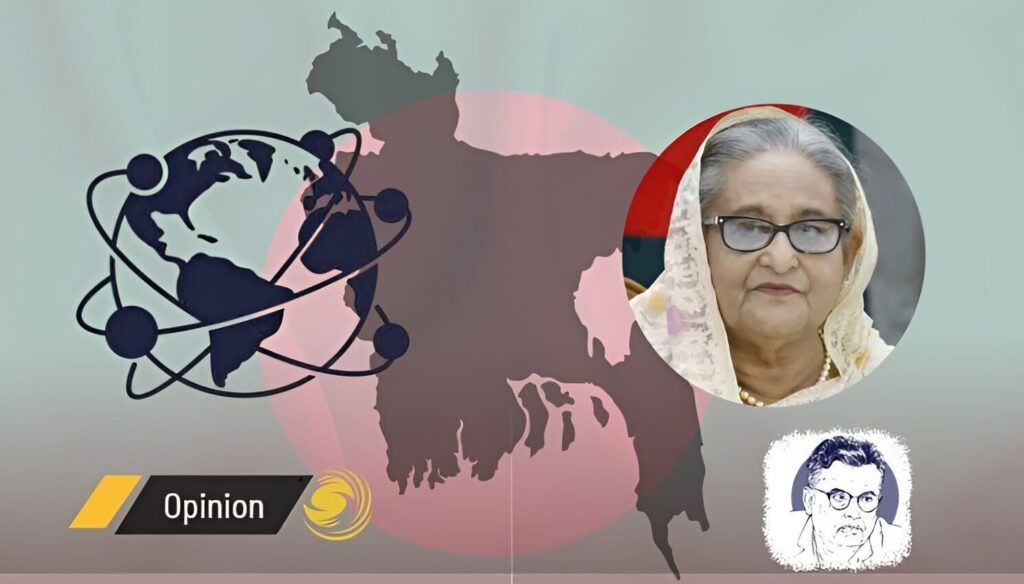
Following the change in state power in Bangladesh through Yunus’s meticulous design, and the continuation of that process, Bangladesh’s geopolitical importance has now become a major subject of discussion.
Bangladesh does not enjoy even a fraction of the freedom enjoyed by journalists in Pakistan. It is therefore impossible to write openly about Bangladesh’s geopolitical importance. Nevertheless, the matter may become somewhat clearer by referring to what those in positions of power have themselves said. When Begum Zia was on her deathbed, Tarique Rahman published a post on Facebook. Amid the emotion of that post, one line was particularly noteworthy: “The question of my return does not depend solely on my own decision.” Since then, everyone has been able to see how Yunus-2 was put into effect and what form this Yunus-2 has taken.
Even after Tarique Rahman’s return and his assumption of office as prime minister, the issue currently under discussion regarding Bangladesh’s geopolitics is not, as it is in many other countries, about borders, waterways, seaports, maritime routes or navigation. The principal concern in the discussion of Bangladesh’s geopolitics is the country’s internal stability.
Nor is it true that those inside and outside the country who supported or spoke in favour of the change of government in Bangladesh in 2024 wanted voting rights for the people of this country or a proper election. By describing a farcical election such as the election of 12 February as an election and a return to democracy, they have demonstrated that, in reality, what they wanted was neither an election nor the exercise of voting rights.
Moreover, over the past decade, the world has witnessed the consequences of frequent general elections in Britain, the birthplace of democracy, the referendum on Brexit, the mistaken decision to leave the European Union through a vote and, above all, the appointment of seven prime ministers within ten years. Because the British people made a mistaken decision through a referendum, and because no stable government emerged even after elections, the country’s economic and social development has not merely stalled; it has gone into reverse. Poverty is increasing every day.
A great deal of analysis is being conducted regarding this political condition in Britain. These analyses have brought several important questions concerning the future structure of the state to the forefront. Some analysts, for example, have said that public anger can be used to change a government, but once one assumes office, the greater challenge immediately presents itself: the competence required to govern the state. The geopolitical importance and economic development of any state depend upon the competence of those who govern it. The most important dimension of that competence is the extent to which the ruler can maintain stability in the state, the government and society. The validity of this analysis is borne out by the latest article written by former British prime minister Rishi Sunak. He has said that before becoming prime minister or head of government, one may speak of many excellent plans, but after sitting in the prime minister’s chair, it becomes apparent that reality is different. It is then that the questions of competence and efficiency arise. In this world, failure offers the greatest opportunity to recognise what is correct. Rishi Sunak became prime minister from his position as finance minister after presenting a programme of economic reform and, to a considerable extent, engineering what resembled a political coup within his party. His present realisation has therefore emerged from his own failure. For that reason, his experience must be given due importance.
The change in state power in Bangladesh was brought about by exploiting public anger over the absence of a proper election, creating a camouflage among students around the issue of government employment, and combining this with the killing of police personnel, members of the BGB and members of the armed forces, killings carried out with unidentified sniper rifles and, above all, the use of Rohingya and Bihari communities for looting and the destruction of various state installations.
There are now many claimants to the success of this undertaking. During this year’s observance of July, local BNP leaders in Jatrabari and various other places were seen claiming that, following telephone instructions from their leader, they had attacked the police, carried out all the other operations and brought down the government. Yunus claims that it was the product of his “amazing meticulous design”. For that reason, the state continues to accord him respect and protection. Jamaat-e-Islami claims that it was the principal force responsible for overthrowing the government. Yet these three forces are, in essence, natural allies. In reality, there is no difference among them.
Within this debate, journalist Matiur Rahman Chowdhury has advanced a theory that whenever this type of change in state power occurs in Bangladesh, the BNP benefits. In other words, after the political change of 15 August 1975, Major General Ziaur Rahman came to power and created the BNP. After the fall of Ershad in 1990, the BNP came to power. This time, following the overthrow of Sheikh Hasina’s government, Yunus came first, and now, as a continuation of that process, the BNP is in power. In this manner, he presents the BNP as the party that has benefited the most.
Bangladesh’s political history, however, also offers the opposite pattern. After the Awami League won the election in 1970, Yahya Khan denied it state power and banned the party. As a consequence, Pakistan itself broke apart. The Awami League created Bangladesh and assumed power. On 15 February 1996, the BNP held an election excluding the Awami League. The result is recorded in the history of Bangladesh: the BNP remained in power for the shortest period in its history, while the Awami League returned to state power after 21 years. Again, when the BNP attempted in 2007 to hold an election excluding the Awami League, the 1/11 episode occurred in the country, and two years later the Awami League came to power in Bangladesh for an extended period.
On the other hand, on each of the three occasions when the BNP came to power, it failed to bring stability to the country. Ziaur Rahman’s period in office was spent attempting to establish discipline in various sectors. Even by sacrificing his own life, Ziaur Rahman could not accomplish that. Almost from the beginning of the BNP’s rule from 1991 to 1996, large-scale and clearly visible electoral manipulation in the Mirpur and Magura by-elections brought to the forefront the demand for the formation of a non-political government, such as a caretaker government. That demand then led to more than two years of parliamentary boycotts by the opposition and an intense movement on the streets. In other words, the BNP could not establish stability. The BNP was subsequently in power from 2001 to 2006. During that period, 554 bombs were detonated in 63 districts on a single day, militants such as Bangla Bhai and Shaykh Abdur Rahman emerged, opposition leaders were attacked and killed in broad daylight on 21 August, the most extensive possible attempt was made to assassinate the principal opposition leader, and ten truckloads of illegal weapons were unloaded under the cover of darkness at Chattogram Port. Taken together, the BNP was unable to bring stability to the country.
At that time, just as Far Eastern Economic Review magazine described Bangladesh as a “cocoon of terrorism”, foreign media also published reports regarding Osama bin Laden’s entry into and presence in Bangladesh. Similarly, after Tarique Rahman returned to the country, TIME published a cover story on him. The title of that cover story may be left unmentioned, but the article stated that his mother had been in power twice, yet there was nothing distinguished about either period of her rule.
This time, the BNP came to power in the final week of February through an election conducted under military supervision. There is no need to compare the results of this election with Tarique Rahman’s Facebook status before his return to the country. Even so, it can be seen that, in the interest of maintaining law and order, the military remained deployed on the streets with magisterial powers until 30 May. Once again, from 22 June to 30 June, the military was deployed in six additional districts, including three metropolitan cities.
Within two weeks of this, the IMF said that Bangladesh’s GDP growth would stand at 3.5 percent during the current quarter and that, if the country continued on its present course, it would fall below 3 percent in the following quarter. Many foreign news organisations framed their reports in language indicating that only three years ago, the country had a story of maintaining an upward GDP growth rate of more than 6.5 percent, whereas it is now signalling that its GDP growth may fall below 3 percent.
On the other hand, at the time of writing, in the latest interview given by deposed prime minister Sheikh Hasina to Reuters, the news agency wrote in its accompanying report that Sheikh Hasina had announced her return to the country at a time when the Bangladesh government was attempting to establish stability. The wording of those lines also carried an implicit concern over what would happen to the country’s stability after her return.
Based on the information, data and other indications available so far, it is certain that Sheikh Hasina is returning to the country. She has said that it will happen by around December. It may therefore occur at any time before December or close to December.
How the government handles Sheikh Hasina’s return to the country, and how much political prudence it demonstrates in doing so, will also be important. Here too, the country’s stability will depend upon the government’s political decisions and the condition of the national economy. The geopolitical dimension may, for the moment, be left aside.
Yet one thing is certain: the Iran-US war will intensify further around September. As a consequence, the prices of oil, fertiliser and other commodities will rise. Again, following the Houthi attack on Saudi Arabia and the response given by Pakistan, Pakistan may become involved in that war at any time. Pakistan’s Balochistan and separatist problems are no longer merely separatist issues; they have become political problems. On the other hand, there are indications that the conflict between the Arakan Army and the Myanmar government along Bangladesh’s border with Myanmar will also assume a larger form by around September.
Moreover, the shell has fallen away from the trend of religious politics, or politics wrapped in religion, that had been visible across the world for a period. It is becoming increasingly clear that religious politics, or politics wrapped in religion, is not a form of soft power like democracy or nationalism. It is essentially a form of hard power resembling the seizure of a state by the sword.
At this time, when the election of 12 February is considered alongside the history of previous elections held during the BNP-Jamaat periods, Jamaat and the BNP no longer possess a soft power such as democracy. On the other hand, these forms of so-called nationalism wrapped in religion and presented in the name of Bangladeshi nationalism are becoming increasingly like swords across the world. Under such circumstances, what soft power will remain in the hands of the government for preserving stability?
And yet, at this moment, the principal demand arising from both the geopolitical context and the condition of the national economy is stability in Bangladesh.
The author is a recipient of the country’s highest state award, a journalist, and editor of Sarakhon and The Present World.
More by Swadesh Roy
 In 1971, Not Durga but Indira Gandhi; Chinmoy in Prison and Durga, the Village Girl
 Rammohan and Women’s Emancipation: East Bengal’s Brahmo Samaj and Rahul GandhiIs the Ganges Water Treaty Heading Towards a December Deadlock?Can “People-to-People” Diplomacy Exist Where More Than Half the People Are Invisible?