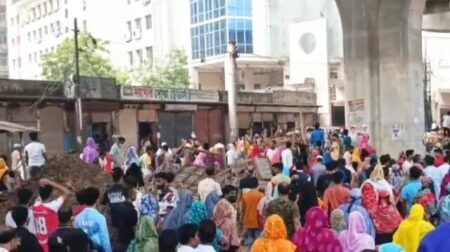

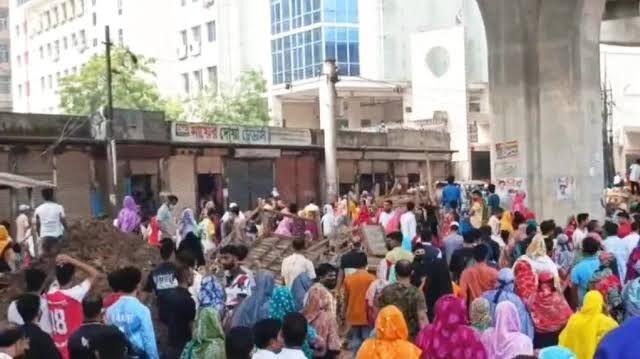
The blockade of the Dhaka–Tangail Highway in Chandra, Gazipur, clashes between workers and police, and the closure of several factories on October 31 marked another expression of deep-rooted discontent in Bangladesh’s ready-made garment industry. The workers’ movement demanding a minimum monthly wage of Tk 30,000 is no longer confined to a single factory or industrial area. Protests over the same demand have spread across Konabari, Mouchak and Chandra in Gazipur, as well as Ashulia.
Viewing the situation merely as a problem of road blockades or law and order would obscure the underlying causes. The unrest stems from longstanding wage dissatisfaction, rising living costs, fewer opportunities for overtime, job insecurity, and mounting production and competitive pressures on the garment industry. It also raises a fundamental question: who is responsible for ensuring a minimum standard of living for the workforce on which the country’s leading export-earning sector depends?
At noon on October 31, workers at the Interstoff factory in the Chandra Palli Bidyut area of Kaliakair upazila, Gazipur, stopped work and took to the highway. Workers from several nearby factories, including Divine Textile, later joined the protest. The blockade began at around 2:30pm, causing lengthy traffic congestion on the Dhaka–Tangail Highway. At around 5:30pm, police attempted to disperse the workers, triggering chases and counter-chases that escalated into clashes. Tear gas and sound grenades were used. Traffic returned to normal at around 7:30pm.
Workers claimed that more than 50 people were injured in the clashes. However, reports differed over the number of casualties and the details of the incident. Some accounts reported at least 30 injuries and vandalism involving 15 vehicles. Although the final number of injured remains unconfirmed, the incident clearly reflects the growing tension and spread of unrest across the industrial area.
The protesters say their current wages are no longer enough to support their families. Prices of essential goods have risen, but their incomes have not increased at the same pace. In the past, workers could supplement their earnings through overtime, but opportunities to do so have declined at many factories. As a result, workers who depend on their regular wages are finding it increasingly difficult to cover rent, food, transport, medical expenses and their children’s education.
The significance of this discontent is even greater because disputes over wages in Bangladesh’s garment industry are not new. Despite the wage revision in 2023, a substantial gap remains between workers’ incomes and the cost of living. Protests have continued even after the government announced its decision to form a new wage board. For workers, the announcement alone is not enough. They want to know how much the new minimum wage will be, when it will take effect and how much it will actually improve their living conditions.
From Tk 12,500 to Tk 30,000: The Cost-of-Living Behind the Demand
The minimum wage in Bangladesh’s ready-made garment industry was last revised in 2023. According to the government gazette published on December 20 that year, the minimum monthly wage for garment workers was set at Tk 12,500. Before that, the minimum wage in the sector was Tk 8,000. The new wage structure came into effect in December 2023.
In the nearly three years since then, workers have faced mounting pressure from the cost of living, rent, food, transport and medical expenses. This has raised questions about how realistic the 2023 wage structure remains under current economic conditions.
According to the Bangladesh Bureau of Statistics’ September 2026 figures, overall inflation stood at 8.34 per cent. Food inflation was 7.22 per cent, while non-food inflation reached 9.30 per cent. Rising non-food costs have placed additional pressure on working-class families as they struggle to pay rent, cover transport costs, meet medical expenses and manage other regular household bills.
There is an important economic distinction here. Even when the rate of inflation falls, market prices do not return to their previous levels. A decline in inflation generally means that prices are rising more slowly, not that they are falling. The higher cost base created by several years of elevated inflation continues to put pressure on workers’ incomes.
Consider a worker earning Tk 12,500 a month. That amount must cover rent, food, commuting costs, medical care, clothing and other household expenses. In many workers’ families, several members depend on this single income for their upkeep. Therefore, even when nominal wages rise, the crucial question is how much purchasing power actually improves relative to family size and total expenses.
The workers’ demand for Tk 30,000 represents a 140 per cent increase over the current minimum wage. That is a substantial gap. But judging the demand solely in percentage terms would fail to capture workers’ actual circumstances. Any revision of the minimum wage needs to take into account household size, housing costs, nutrition, healthcare, education, transport and working hours.
At the same time, the fact that workers are demanding Tk 30,000 does not automatically mean that every factory can implement such an increase immediately. Wage-setting must consider both workers’ basic living needs and the financial capacity of the industry. However, the industry’s competitive pressures cannot be used as a justification for ignoring workers’ minimum requirements for a decent standard of living.
Are Workers’ Incomes Rising, or Is Their Purchasing Power Declining?
To assess the effectiveness of wage increases, it is not enough to look only at the rate of nominal wage growth. It must also be compared with inflation. If workers’ wages rise more slowly than prices at the national level, their real purchasing power declines.
According to the September 2026 figures, overall inflation stood at 8.34 per cent. However, conditions vary across occupations, regions and income groups. In the case of garment workers, their actual earnings must be assessed by taking into account regular wages, overtime payments and other benefits.
Overtime is particularly important. Many workers’ monthly household budgets do not depend solely on their basic wages. Money earned through additional working hours also forms part of their family income. But when factory orders decline or production is reduced, opportunities for overtime become more limited. As a result, even if the officially set wage remains unchanged, the amount workers take home may fall.
For this reason, workers’ complaints about declining overtime opportunities deserve particular attention. This is not merely a question of supplementary income; it also reflects the relationship between production conditions, working hours and workers’ earnings.
New Wage Board: Workers Await Decisions, Not Just Announcements
Amid the labour unrest, the government has announced a decision to form a new wage board. On October 28, Labour and Employment Minister Ariful Haque Chowdhury said the gazette would be published soon after the lists of representatives from the owners’ and workers’ sides were received.
In his statement on October 31, the minister provided further details. Following a meeting with representatives of the Bangladesh Garment Manufacturers and Exporters Association (BGMEA) and the Bangladesh Knitwear Manufacturers and Exporters Association (BKMEA) at the Labour Building in Bijoynagar, he said a decision had been made to publish the gazette establishing the new wage board on November 1. According to him, both the owners’ and workers’ representatives had agreed to the formation of the board. The meeting also discussed the payment of workers’ outstanding wages and other dues.
This is an important institutional step towards resolving the crisis. However, forming a wage board and implementing a new wage structure are two separate matters. The board’s task will be to consider the views of the relevant parties, the cost of living, the industry’s capacity and labour-market conditions before making its recommendations. The government will then have to make a decision based on those recommendations.
The most important question for workers is how long the process will take. If discussions drag on for an extended period after the board is formed, discontent could deepen. On the other hand, a decision made hastily, without adequate information and assessment of actual conditions, may not prove sustainable.
The new board will therefore need to give priority to several issues: the real purchasing power of current wages, workers’ household expenses, the impact of inflation, dependence on overtime and the financial capacity of different types of factories. Setting a single minimum figure will not resolve every problem affecting workers’ living standards. Other levels of the wage structure and employment benefits also need to be reviewed.
Workers’ Demands on One Side, an Industry Under Pressure on the Other
Bangladesh’s garment industry is facing the wage debate at a time when its own economic position is under pressure. Although export earnings from the sector are among the country’s principal sources of foreign currency, the industry faces major challenges from international orders, production costs, energy supplies, bank financing and competition.
According to published statistics, Bangladesh’s garment export earnings stood at $38.70 billion in the 2025–26 fiscal year, down from $39.35 billion in the previous fiscal year. This represents a decline of approximately 1.65 per cent in one year.
The figures show that despite the sector’s substantial export earnings, its growth is not always positive. Price pressures from international buyers, uncertainty over orders and rising production costs have squeezed the profit margins of many factories.
According to information presented by the Commerce Minister in Parliament, 402 garment factories closed between July 2023 and June 2026. Of these, 282 were members of the BGMEA and 120 were members of the BKMEA. Global economic pressures, domestic political instability, liquidity constraints in the banking sector and rising production costs were cited as reasons for the closures.
These figures make the wage debate more complicated. On one side, workers say their current incomes are insufficient to support their families. On the other, many factory owners argue that rising production costs and financial pressures make it difficult to bear the additional expense of higher wages.
But finding a solution between these two realities requires answering a fundamental question: will the burden of the industry’s problems be addressed primarily by keeping workers’ wages low?
Factory operations face challenges involving energy, raw materials, financing, transport, technology and productivity. If these problems remain unresolved and low wages are treated as the principal means of maintaining competitiveness, the industry may find it increasingly difficult to retain skilled workers in the long term. At the same time, wage increases must be designed in a way that does not place unreasonable pressure on production and employment.
402 Factory Closures: Employment Insecurity Is Growing
The number of factory closures is directly linked to the question of workers’ employment security. When a factory shuts down, the impact extends beyond the workers who lose their jobs. Their families’ incomes, local businesses, transport services, rental markets and other service sectors are also affected.
A report published in July 2026 said that more than 19,000 workers had lost their jobs because of factory closures during the preceding six months. It also noted that three to four factories had been closing on average every month amid declining orders, energy shortages and rising production costs.
This has created a contradictory situation. Workers are demanding higher wages at a time when the jobs of many others have become increasingly uncertain. Therefore, alongside wage increases, the new wage board must also consider how to preserve employment.
However, the number of factory closures cannot be used to portray workers’ wage demands as unreasonable. Not all factories are in the same financial position. Large exporters, medium-sized factories and small subcontracting businesses have different levels of capacity. Some companies face a shortage of orders, others struggle with bank loans, while some are affected by production costs and management weaknesses.
The industry’s overall problems therefore cannot simply be placed at the feet of workers. Equally, it would be unrealistic to assume that all factories have the same financial capacity and seek solutions through a uniform policy.
Why Have Road Blockades Become a Major Form of Workers’ Protest?
The incident in Chandra has raised another question: why do workers repeatedly have to block highways to press their demands?
An effective grievance-resolution mechanism is essential in addressing labour unrest. When disputes arise over wages, overtime, leave, dismissal or other employment benefits, workers need to know where they can turn, how quickly their complaints will be addressed and whether the resulting decisions will be implemented. Workers’ confidence depends on these factors.
When factory-level worker representation, participatory dialogue and effective grievance-resolution procedures are weak, dissatisfaction continues to build. Eventually, a dispute at one factory can spread to neighbouring establishments. The participation of workers from nearby factories, including Divine Textile, in the protest by Interstoff workers in Chandra is an example of how discontent can spread.
On the same day, labour unrest and clashes with police also occurred in Ashulia. Alongside demands for higher wages, workers there raised concerns over alleged blacklisting, an end to dismissals and job security. Various reports said that numerous factories in Ashulia and Gazipur had declared holidays or suspended operations.
This shows that labour unrest is not limited to demands for higher wages. Workplace safety, fear of losing jobs, workers’ right to organise and opportunities for dialogue with management are also part of the problem.
Highway blockades, meanwhile, cause serious hardship for the general public. The experiences of bus drivers and passengers stranded in Chandra illustrate the impact. One passenger travelling to Dhaka for urgent business had to get off the bus and continue on foot. Transport workers also lost working hours and income.
Workers have the right to pursue their legitimate demands, just as members of the public have the right to move freely. Protest programmes should be organised in a way that does not unnecessarily disrupt other people’s lives and livelihoods.
Mohammad Ashrafuzzaman, organising secretary of the National Garment Workers’ Alliance Bangladesh, has also called on workers to maintain peaceful programmes. According to his statement, the demands include the formation of a new wage board and an increase in the minimum wage to Tk 30,000. However, programmes that could cause public suffering or damage to life and property should be avoided.
The Role of Police: Dialogue Must Accompany Law Enforcement
The police have responsibilities beyond clearing roads when responding to labour protests. Alongside maintaining order, it is important to prevent confrontation and create an environment in which workers can express their concerns.
In Chandra, clashes broke out when police attempted to disperse the workers. Tear gas, baton charges and sound grenades were used before the situation came under control. But the restoration of normal traffic after a clash does not mean that workers’ grievances have been resolved.
Repeated incidents of this kind can deepen mistrust between workers and law enforcement agencies. As a result, even a minor dispute could escalate into a major confrontation in the future.
For this reason, regular communication among the administration, industrial police, Department of Labour, factory management and workers’ representatives is essential in addressing labour unrest in industrial areas. Dialogue should not begin only on the day of a protest. Effective mechanisms for resolving disputes need to be established in advance.
The Economic Case for Higher Wages
Two different arguments generally emerge in debates over wage increases. Workers argue that the cost of living has risen and wages must therefore increase. Factory owners, on the other hand, say that higher production costs could weaken Bangladesh’s competitiveness in international markets.
Both arguments have an economic basis. But an industry cannot sustain its competitiveness over the long term by keeping workers’ wages low.
First, when workers earn too little, their nutrition, health and overall living standards suffer. This affects their ability to work and their productivity.
Second, higher incomes among workers can increase consumer spending in the local economy. Workers spend a large share of their additional earnings on food, clothing, rent, medical care and other essential goods. This creates demand in local markets. In other words, higher wages do not simply increase workers’ personal incomes; they can also strengthen domestic demand across the economy.
Third, fair wages and better working conditions help factories retain skilled workers. Frequent job changes, absenteeism and dissatisfaction can disrupt production and cause losses for factory owners as well.
However, wage increases need to be accompanied by improvements in productivity. Without better machinery, skills development, worker training, improved energy management and modernisation of production processes, changes to the wage structure alone will not ensure the industry’s long-term competitiveness.
What Should Be Considered in the New Wage Structure?
The biggest challenge facing the new wage board is to strike a balance between workers’ actual living costs and the financial capacity of the industry.
Several issues deserve particular attention.
First, setting the minimum wage should not rely solely on the national average inflation rate. The actual costs of rent and transport in industrial areas of Dhaka and Gazipur, particularly Savar and Ashulia, must also be taken into account.
Second, the distinction between basic wages and gross wages must be made clear. Allowances for housing, medical care, transport and other expenses should be structured in a way that increases workers’ actual incomes.
Third, the wage structure should reduce workers’ dependence on overtime. It is essential to ensure that a worker can earn enough to support a family within regular working hours.
Fourth, reliable information is needed to assess factories’ financial capacity. Decisions should not be based solely on statements from either owners or workers without examining the actual situation regarding orders, production costs, export earnings, bank loans and profits.
Fifth, the timely payment of wages must be ensured. In his October 31 statement, the Labour Minister urged factories to clear outstanding wages and other dues promptly. In addition to setting wages, authorities must monitor whether they are being paid regularly.
The Solution Goes Beyond the Wage Board
The current situation in Bangladesh’s ready-made garment industry has raised an important policy question. If workers in a sector that underpins the country’s export earnings and provides employment to millions cannot secure a minimum standard of living, the industry’s long-term stability will also be at risk.
At the same time, wage-setting that ignores the industry’s financial capacity, production costs and international competition will not resolve the problem either. What is needed is a framework that improves workers’ living standards while ensuring sustainable production and employment.
The government’s responsibility therefore extends beyond forming a wage board. Effective initiatives are also needed to improve energy supplies, address problems with bank financing, expand export markets, upgrade technology and strengthen the capacity of small and medium-sized factories. Factory owners, for their part, must ensure the timely payment of workers’ dues, safe working conditions and regular dialogue with workers’ representatives.
Workers’ organisations also have a responsibility to keep protest programmes peaceful and disciplined. If demonstrations involve violence, factory vandalism or the disruption of public movement, public support for workers’ legitimate demands may be undermined.
The highway blockade by workers in Chandra, Gazipur, was therefore more than a day of traffic congestion or a clash with police. It was an important signal of the underlying contradictions between the country’s industrial policy, labour policy and economic development.
The new wage board will determine how much of the Tk 30,000 wage demand can ultimately be implemented. But the larger question is whether Bangladesh’s garment industry can build a production system in which workers’ living standards improve, owners’ investments remain sustainable and the country retains its competitiveness in international markets.
The answer does not rest solely with workers or factory owners. The future of Bangladesh’s garment industry will depend on the collective efforts and decisions of the government, industrialists, workers’ organisations and policymakers.