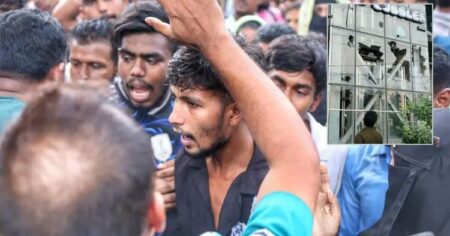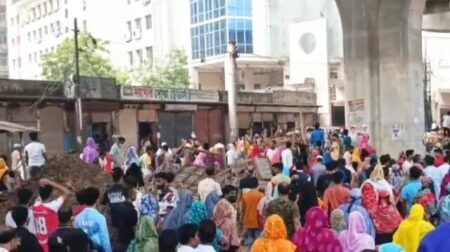

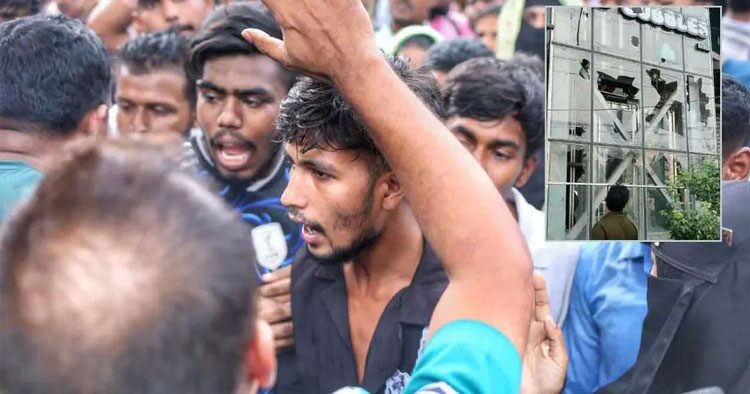
Mirpur-10 roundabout in Dhaka, usually crowded with buses, rickshaws and metro rail commuters, turned into a scene of confrontation on Sunday morning, November 1. Garment workers demanding a minimum monthly wage of Tk 30,000 took to the streets, while police were deployed to control the situation. Clashes soon broke out, involving chases, brick-throwing and police baton charges.
Police used water cannons, tear gas and sound grenades to disperse the protesters. Some workers also threw bricks and stones at police. Traffic was severely disrupted throughout the morning and into the afternoon across Mirpur-10, Mirpur-11, Mirpur-12 and surrounding areas.
But the clashes cannot be understood simply as a road blockade or a law-and-order problem. The demand for a Tk 30,000 minimum wage reflects deeper tensions within Bangladesh’s garment industry, including rising living costs, the widening gap between wages and household expenses, production pressures and strained relations between workers and factory owners.
In recent days, protests over the same demand have spread beyond Mirpur to Ashulia in Savar and several industrial areas in Gazipur. Sunday’s violence was therefore part of a broader wave of labour unrest rather than an isolated incident.
Tensions Escalated Throughout the Morning
Sunday’s protest began around 8am, when workers from several garment factories gathered at Mirpur-10 roundabout and blocked the roads. By around 9am, several hundred workers had brought traffic to a standstill on major connecting roads. Movement was also disrupted between Mirpur-11 and Agargaon, and between Mirpur-2 and Mirpur-13.
Traffic police initially tried to divert vehicles through alternative routes. However, as the workers maintained their blockade, tensions continued to rise.
Clashes began at around 11:15am after police repeatedly asked the protesters to clear the roads. When some workers threw bricks at officers, police responded with baton charges, followed by water cannons, tear gas and sound grenades.
The first round of clashes subsided around 11:45am, but workers regrouped from different directions, triggering further confrontations.
According to police, tensions escalated after an individual suspected of being involved in a mugging was detained and held at a police box. Police said the clashes began when workers approached the police box from several directions. Accounts of how the confrontation started, however, differ among the parties involved.
By midday, normal traffic had yet to resume in Mirpur-10. Although police had secured the roundabout, congestion spread to surrounding roads.
Days of Accumulating Anger
The unrest in Mirpur had been building for several days. Since October 29, garment workers have repeatedly blocked roads in different parts of the area over the same wage demand.
On October 31, the protests spread further. Demonstrations and road blockades in Mirpur-10, 11 and 12, as well as the Proshika intersection, disrupted traffic for several hours.
On Saturday afternoon, a section of protesters moved towards Shah Ali in Mirpur-1, where clashes reportedly broke out with security personnel at a garment factory. Reports also emerged of vandalism at Himalaya Garments and the adjacent Baghdad Shopping Complex. Stones were also thrown towards a garment factory in the Kalshi area.
Nearly all garment factories across greater Mirpur remained closed on Saturday because of the unrest. Around 50 factories in Ashulia and Gazipur also had to suspend operations. Clashes between workers and police in Ashulia and Kaliakair left several people injured on both sides.
The developments indicate that labour unrest had already spread beyond the capital before Sunday’s confrontation.
From Tk 12,500 to Tk 30,000: The Wage Dispute
At the heart of the protests is the minimum wage for garment workers. The current entry-level monthly minimum wage in Bangladesh’s garment industry is Tk 12,500, set by the Minimum Wage Board in November 2023. Previously, the minimum wage had been Tk 8,000. The revised structure took effect on December 1, 2023.
Workers are now demanding Tk 30,000, an increase of Tk 17,500, or approximately 140 per cent over the existing minimum.
They argue that the wage fixed three years ago is no longer sufficient to support a household amid rising prices. Food, rent, transport, healthcare and children’s education have all become more expensive, while incomes have not increased at the same pace.
Many long-serving garment workers say that even after working extended hours and overtime, their monthly earnings are insufficient to meet household expenses. A worker earning Tk 18,000 to Tk 20,000 a month, for example, may spend Tk 8,000 on rent alone. The remaining amount must cover food, transport, healthcare and other family expenses.
This example does not represent the income and expenditure patterns of every garment worker, but it illustrates the growing gap between wages and the cost of living.
Another concern among workers is the lack of confidence in verbal assurances. Some say they will continue protesting until a formal decision is announced, despite hearing that discussions on wage increases are under way.
New Wage Board, But Can It Restore Trust?
Amid the unrest, the government announced on November 1 the formation of a new six-member Minimum Wage Board.
Labour and Employment Minister Ariful Haque Chowdhury said the board was formed after consultations with workers’ representatives and industry stakeholders. He also urged workers to return to their jobs.
Such boards generally include representatives of the government, workers and employers, along with an economist and an independent representative. Their responsibility is to recommend a revised wage structure covering different categories of workers.
Following the 2023 wage revision, the time for another review is approaching. Under the amended labour law, minimum wages in different sectors are to be reviewed every three years. On that basis, the garment industry’s wage structure is due for review by December 2026.
However, forming a board alone may not be enough to end the protests. Workers want clarity on representation, transparency in negotiations, the timeline for decisions and the date when any revised wages will take effect. Demands have also emerged for workers to have proper representation on the board.
Industry representatives have also expressed support for reviewing wages. BGMEA Vice-President Mohammad Rezwan Selim said employers also wanted workers’ wages to increase, but stressed that decisions must take the industry’s current conditions into account.
Workers’ Wages and the Industry’s Competitive Pressures
Bangladesh’s garment industry is more than a major manufacturing sector; it is the country’s principal source of export earnings.
According to Reuters, the industry employs around four million people and accounts for more than 80 per cent of the country’s total export earnings. Its contribution to gross domestic product is also approximately 10 per cent.
Prolonged labour unrest could therefore have consequences well beyond individual factories. Production shutdowns may disrupt export schedules and delay deliveries to international buyers. Payments from overseas customers could also be affected, ultimately putting pressure on workers, factory owners and the wider economy.
Factory owners, meanwhile, face their own challenges. Rising production costs, irregular gas and electricity supplies, and uncertainty in international markets have placed additional pressure on the industry.
The wage issue is therefore not simply a matter of bargaining between workers and employers. It is also connected to productivity, international competitiveness and the industry’s long-term capacity to sustain operations.
However, competitive pressures cannot justify ignoring workers’ living conditions. Equally, wage increases should be structured in a way that does not undermine production or employment. The challenge is to establish a wage framework that reflects workers’ basic living costs while taking the industry’s economic capacity into account.
Reuters has reported that between 25 and 30 factories in Gazipur have been forced to close amid the ongoing unrest. Border Guard Bangladesh personnel have also been deployed there to help control the situation. If the protests continue, export deliveries and payment schedules involving international buyers could face disruption.
What the Mirpur Clashes Really Reveal
The confrontation in Mirpur raises immediate questions about law and order. Road blockades, vandalism, brick-throwing and attacks on police cannot be considered acceptable forms of protest. At the same time, the use of force against workers cannot provide a lasting solution to their grievances.
The incident also exposes shortcomings in communication between workers, the government, factory owners and labour representatives. If dissatisfaction over wages had been building for several days, why was an effective solution not found before the dispute escalated into street violence?
Simply urging workers to return to their jobs will not restore normalcy. Their demands need to be assessed, household living costs taken into account and a credible process for wage negotiations established. Worker leaders also have a responsibility to prevent vandalism and violence in the name of protest.
Mirpur-10 roundabout may reopen to traffic within hours. Metro rail services may continue, buses may return and shops may reopen. But unless the widening gap between wages and living costs, uncertainty over pay and accumulated grievances in industrial areas are addressed, similar unrest could erupt again.
Whether the Tk 30,000 demand is economically achievable, how much the new wage board will recommend and whether factory owners will accept its proposals remain open questions.
One point, however, is clear: ensuring stability in Bangladesh’s largest export sector requires stability in the lives of the workers who sustain it.
The clashes in Mirpur were therefore about more than a confrontation between garment workers and police. They have brought into focus broader questions about the future of Bangladesh’s garment industry, workers’ living standards and who ultimately benefits from the country’s economic growth.
Meta Description: Garment workers demanding a Tk 30,000 minimum wage clashed with police in Mirpur, exposing deeper tensions in Bangladesh’s garment industry.