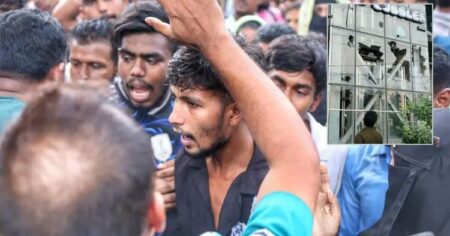


Barely two or three months into Yunus’s tenure, five to seven young men from the Awami League, whose activities had been banned, would suddenly take to one street or another and march for a few minutes. Sometimes one or two of them would be arrested on the spot. And of those arrested, one or two would climb into the police van still chanting “Joy Bangla.”
Seeing what had become of a party that only days before had wielded such formidable power over the state, a foreign gentleman asked me a question that went something like this. “Well, this political party is finished. Why, then, are these five to seven young men still taking such risks, going to jail, falling into the hands of mobs?”
The gentleman had already taken it for granted that the party was finished, so I let that pass and said to him, “Ever since it was born, this party has taken beatings like these and made history.”
“At whose hands?” he wanted to know. “And why has it taken beatings from the very beginning?” I said, “Look, this is a political party born of the soil. Think of the plants native to a land, how they spring from its soil and in time, all together, grow into a forest. That is how this political party grew.”
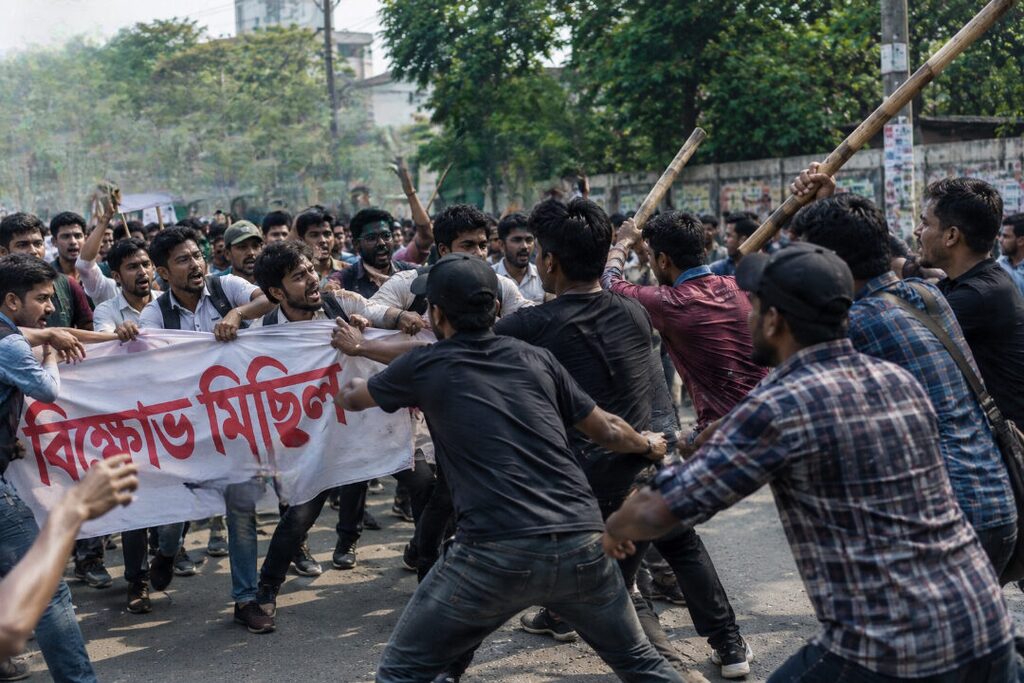
It was from Comrade Toaha that I heard the story of the beatings they took in those early days. You may not know Comrade Toaha, but one of the men who came under attack later served as Acting President of Bangladesh during the country’s War of Independence. His name was Syed Nazrul Islam. According to Comrade Toaha, a few of them got together at SM Hall at the University of Dhaka and formed the Awami Muslim Chhatra League, and Syed Nazrul Islam became president of its hall branch. At the time, they were in favour of making Bangla a state language. For that, Muslim League thugs from Old Dhaka would attack them whenever they stepped outside the hall and would even come into the hall at night to attack them.
For every such chapter in the party’s life, the pages of Bangladesh’s history hold many accounts of the beatings its people took and the times they went to jail.
The gentleman then asked whether I had ever before seen them with my own eyes in such desperate straits, taking beatings, going to jail or marching just a handful at a time.
I told him that in the worst days this party had known, I had seen just such marches, a handful of people marching for two or three minutes.
Before I could finish, he said, “But surely the worst times for this party were 1971 and, more recently, 2024. Is it 1971 you are talking about?”
I said to him, “Look, the worst time for this party was after 15 August 1975. For whatever others, political analysts included, may think, in 1971 the party workers themselves believed that even with their leader in a Pakistani prison, they still had their leader. And that no one had the power to hang their leader, Sheikh Mujibur Rahman. And that he would come back to them. In much the same way, since 2024, however many of them have been driven from their homes, however long they spend on the run, however many go to jail, they believe that when the time comes, their leader, Sheikh Hasina, will come back to them. And that no one has the power to hang Sheikh Hasina.”

But in 1975, after the murder of Bangabandhu Sheikh Mujibur Rahman and the national leaders, they had, in that sense, no leader. Even then, I saw four or five people suddenly raise the cry of “Joy Bangla” just as a film ended, then melt into the crowd. And from those three or four I saw something grow, until by 1978 the people of this party who had been driven from their homes, even those who for years had spent whole nights in the Sundarbans, were out on the streets in a vast procession. And there, marching alongside them, one would see poor people, barefoot and dressed in lungis. In their eyes I saw a strange intoxication, such was their devotion to this party. To this day I have never understood the language of that intoxication.
The boys and young men I saw on the streets after 1975 were boys and young men I had never seen stride out with such courage in 1973 or 1974, when the party was in power.
I then told him, briefly, that it was in fact in 1966 that the party began to build its ranks of resolute activists, when Sheikh Mujibur Rahman put forward his Six Points, the programme for securing self-rule, and Ayub Khan began arresting party leaders and workers one after another. As Ayub Khan tried to leave the party without a leadership by putting all its leading figures, Sheikh Mujib among them, on trial for their lives, people began coming forward from among ordinary young men and boys, from among workers and peasants, to work for the party. As one round of persecution followed another, some died under the beatings and some emerged as seasoned activists.
In much the same way, after 15 August 1975, when persecution once again descended upon them, a new generation of activists and leaders began to emerge from the struggle.
“What was that persecution like?” he wanted to know. I said to him, “Think back to those days and imagine a college in a subdivisional town, where one of the ordinary students has quietly emerged as a leader of the party’s student organisation. His father, perhaps, earns an honest living running a little eating place beside the railway station. For the son’s offence, the father’s shop is burnt down and the boy is taken to jail. Two years later, after all that time without a trial, the boy walks out of a jail in another district, and the moment he steps off the train at his home station, people drape garland after garland around his neck. And there is something else. There is a new maturity in the way he speaks.”
So one sees that it is precisely when this party is in crisis, when persecution descends upon it, that the activists who will truly fight for it are born. That is why many who have the interests of both the country and the party at heart believe that the party ought, from time to time, to find itself in crisis. At such times, a section of the country’s people, too, comes to see a need for the party as a representative of territorial and cultural nationalism. Once again there emerges a band of activists who have spent their days out in the fields and along the river landings, in the forests and in jail. Meanwhile, the class of leaders that grows up while the party is in power, the men who would have the celestial dancer Urvashi dance for them, inevitably falls away.
For each activist who comes through oppression, beatings and imprisonment carries such weight by then that if you put just one of them on one side of the scales and a hundred of the leaders who had Urvashi dance for them on the other, the hundred together would not equal a grain of that one activist’s weight.
The gentleman asked me whether I meant, then, that when the party was able to return to politics, it would come back as a political party purified by the experience.
I smiled and said that, in my limited understanding, sociology would hardly bear that out. For whatever their ideology, political parties the world over soon fall into the hands of the opportunists among the middle class. And then, little by little, the activists who held fast to their ideals begin to fall behind. We have seen it happen to this party before.
Yet for all that, adversity is always a blessing for political parties of this kind. For iron is quick to rust, and there are any number of ways to adulterate gold. When the fire of adversity melts them down, it does yield some pure iron and some pure gold, and what it yields is enough for these parties to carry on working a while longer for their country and its people and, above all, to carry their own culture forward.
A country’s true political party is one that carries forward the culture that has grown out of its own soil. And whether one calls it sanskriti, culture or krishti, a nation’s capacity to produce and to grow lies within that culture, that krishti, of its own. Outside that culture, one may enjoy the fruits of power, but one can do no good for the country. The history of every country bears witness to that.
The author is a recipient of the country’s highest state award, a journalist, and editor of Sarakhon and The Present World.
More by Swadesh Roy
 In 1971, Not Durga but Indira Gandhi; Chinmoy in Prison and Durga, the Village Girl
 Rammohan and Women’s Emancipation: East Bengal’s Brahmo Samaj and Rahul GandhiIs the Ganges Water Treaty Heading Towards a December Deadlock?Can “People-to-People” Diplomacy Exist Where More Than Half the People Are Invisible?