
Bangladesh can make significant progress in supporting early childhood development by using its existing government healthcare infrastructure. However, simply expanding services to reach more children will not be enough to achieve the desired outcomes. Maintaining service quality, improving the skills of frontline workers, ensuring regular supervision and securing long-term funding are equally important. These issues emerged from a study on early childhood development.
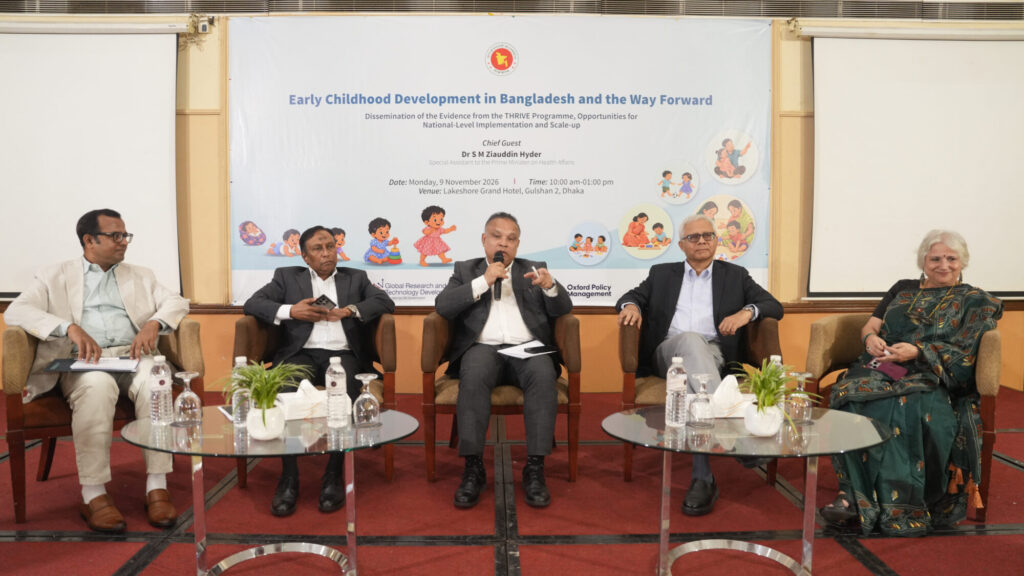
The findings were presented on Monday, November 9, at a national research dissemination event titled “Early Childhood Development in Bangladesh: The Way Forward,” held in Dhaka. At the event, attended by policymakers, researchers and development partners, Dr. Jenna Derakhshani Hamadani, Emeritus Scientist at icddr,b and National Principal Investigator of the Thrive programme, presented the research findings and practical experience.
Programme Reaches More Than 600 Community Clinics
Based on the research, the Strengthening Bangladeshi Babies’ Brains (SB3) programme expanded early childhood development support to more than 600 community clinics across the country.
The programme has reached more than 15,000 children. It has also trained approximately 1,950 frontline health workers and more than 400 supervisors.
The study found significant improvements among participating families in childcare practices, the creation of learning-friendly home environments and the use of play materials.
However, no statistically significant difference was found in overall child development outcomes. Researchers said that expanding the programme alone may not be enough to achieve the expected results unless implementation remains consistent and frontline workers receive regular supervision and adequate support.
Focus on Nutrition and Brain Development
Speaking at the event, icddr,b Executive Director Dr. Tahmeed Ahmed said that child nutrition and brain development are closely linked. Malnutrition during the first few years of life can negatively affect brain development and cognitive abilities.
He stressed the need to give equal attention to nutrition and cognitive development to ensure healthy early childhood development.
Dr. S. M. Ziauddin Haider, Special Assistant to the Prime Minister for Health Affairs, attended the event as the chief guest. He said Bangladesh now has sufficient research-based evidence on the importance of early childhood development. Learning through play, activities that support cognitive development and regular interaction with children all play important roles in their intellectual growth. The benefits also extend into their later education.
He emphasised the need for a national plan to address existing challenges in children’s learning and called for such programmes to reach children and families in every part of the country.
Expansion Must Go Hand in Hand with Quality
Mohammad Golam Kibria, Education Adviser and Team Leader at the UK Foreign, Commonwealth and Development Office, said that expanding a programme nationally means more than simply reaching a larger number of children. It also requires maintaining service quality, strengthening the capacity of frontline workers, securing long-term funding and ensuring government ownership.
A. K. M. Fazlu Zzohha, Managing Director of the Community Clinic Health Support Trust, also praised icddr,b’s work in providing healthcare services to children and mothers. He stressed the importance of drawing on existing experience when expanding early childhood development programmes nationwide.
Discussions at the research dissemination event identified several priorities for the next phase. These include strengthening regular supervision and monitoring, ensuring an adequate number of trained workers, maintaining continuous engagement with parents, securing sustainable funding and establishing government ownership.
The Thrive programme is funded by the UK Foreign, Commonwealth and Development Office’s Global Research and Technology Development Fund and New Zealand’s Ministry of Foreign Affairs and Trade. It is implemented by Oxford Policy Management.
More by Sarakhon Report
 Japan’s Matarbari Port Plan: How Could It Transform Bangladesh’s Economy and India’s Northeast?
 The Bloody Plains of Karbala and the Glorious History of Shia Muslims: A Legacy of Mourning, Faith, and Sacrifice