Sheikh Hasina’s Return Any Time After August and the Politics That Follow

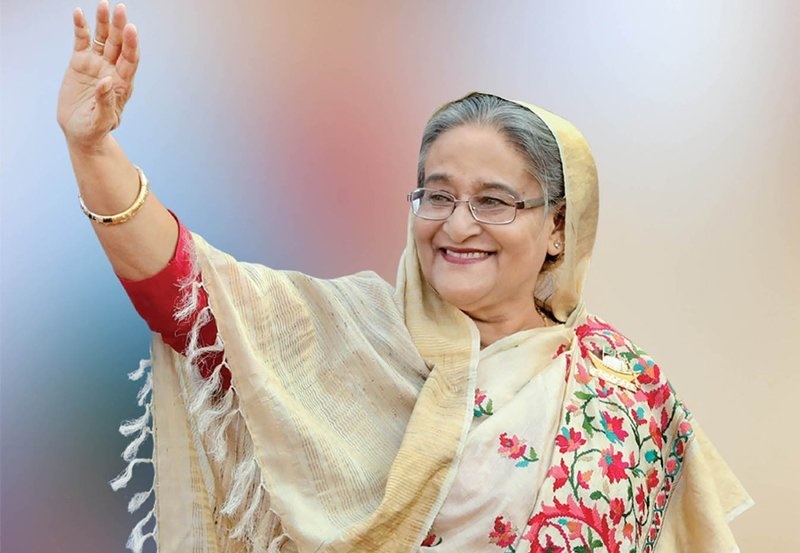
In an interview with India’s influential media outlet NDTV, Sheikh Hasina has said that she will return to the country this year. Her announcement about returning home has been published by almost all major international media outlets.
After the news was published, inquiries made as far as possible indicate that she is not returning in July or August. In reality, a kind of superstition, or blind belief, operates within the Awami League and Sheikh Hasina regarding the month of August. This also exists in the Awami League’s thinking about elections. For example, the Awami League and its leader Sheikh Hasina regard August as a black month, or an inauspicious month. This is because Pakistan came into being on 14 August 1947; on 15 August 1975, through a conspiracy, members of the army killed Bangabandhu Sheikh Mujib along with his family; on 21 August 2004, Sheikh Hasina was subjected to a public assassination attempt through a grenade attack, in which, according to published accounts, 24 people including Ivy Rahman died. Again, on 5 August 2024, according to Dr. Yunus’s meticulous design, the Sheikh Hasina government was brought down.
In the same way, in the case of elections too, the Awami League believes that it cannot win an election except in an even-numbered year. Since 1954, all its electoral victories have come in even-numbered years. Not exactly in relation to elections, but a similar kind of superstition existed even in Mrs. Indira Gandhi, although she was not someone deeply inclined toward belief in the supernatural world and was, rather, a much more modern leader. Although history does not clearly prove it, the founder of the Ottoman Empire, Mehmed, and the Roman hero Julius Caesar are also said to have had certain superstitions of this kind.
Therefore, as far as inquiries suggest, Sheikh Hasina will come at any time after the beginning of September. However, she will by no means wait until December. Those who have observed the politics of the Awami League in the post-independence period for a long time all know that, in reality, the months from December to March belong to the Awami League. This is because this is the period associated with the victory of the Liberation War. That is why, during this time, a different atmosphere is seen to emerge in Bangladesh. And the tempo of December begins to build from September and October. At first glance, it may be said that perhaps for these reasons Sheikh Hasina is taking the timing of her return beyond August.
However, in the case of a politician like Sheikh Hasina, who has been one of the central pillars of Bangladesh’s politics for 45 years and served as the country’s prime minister for 21 years, there is little scope to view her return as an ordinary matter. She is also the only statesperson in the world who, at a time when a meticulously designed conspiracy against her was taking final shape in her own country, used her own country’s security arrangements and a military aircraft to take shelter in a neighboring country with the dignity of state protocol. As the eminent lawyer Mohsin Rashid said on a talk show, “She will not, like you and me, buy a plane ticket and land at the airport. Just as she went in a military aircraft, she will return through an arrangement. And there is an example of that in South Asia itself, where for Nawaz Sharif, a court was set up at the airport and an opportunity was created for him to enter as a free man.” This statement by Mohsin Rashid essentially hints at an international and domestic understanding, and at certain changes in the country’s political position. However, one matter needs to be mentioned here: Sheikh Hasina left the country in a far more dignified position than Nawaz Sharif, and her political asylum also carries far greater dignity. In the country where she is currently staying under “political asylum,” it was not merely that country’s government that gave her shelter; she was given shelter by the state, that is, the elected representatives of all parties of that state gave her shelter through parliament. Therefore, even when Mohsin Rashid’s remarks are considered alongside the status of Sheikh Hasina’s departure from the country and the dignity of her political asylum, there still remains room for further thought.
On the other hand, the eminent journalist and former head of the BBC Bangla department, Sabir Mustafa, who is in many ways fortunate like Fareed Zakaria, because his father too was a famous and respected journalist, said on a talk show that he thinks the government will impose a curfew in Dhaka on the day Sheikh Hasina returns in order to prevent a massive public presence at the airport. Besides this, he also said that if Sheikh Hasina returns, it will be difficult for this government to digest her.
On the other hand, independent member of parliament Rumin Farhana has said that the present government is not in a position to try Sheikh Hasina or punish her. In addition, Rumin Farhana has also said that it is not possible for the government to function by excluding 52 percent of the people. By this 52 percent, she has indirectly pointed to Awami League supporters or Sheikh Hasina’s supporters.
In fact, Sheikh Hasina herself has said in her interview that whatever happens, she will return. And as far as inquiries indicate, by this “whatever happens,” she means that she is prepared to return to the country even if it means going to jail, even if it means taking bullets in her chest. She has given that indication in her interview as well. She said that the blood of her father is mixed with the soil of this country, that the blood of the martyrs of the Liberation War fought under her father’s leadership is mixed with that soil, and that therefore it is there that she wants to return. In other words, she has given the indication of the highest sacrifice of blood in her interview, even mentioning 21 August.
Now the question arises: from where is she getting this courage? And why is Sabir Mustafa saying that the government will not be able to digest her? Why is Rumin Farhana saying that the government is not in a position to try her?
In reality, this position has been created by Yunus through the so-called election of 12 February. Through that election, Sheikh Hasina or the Awami League has felt that victory was theirs. Because before this election, an attempt was made by the Yunus government, together with several other quarters, to create a so-called Awami League or a grassroots Awami League. But Awami Leaguers, even accepting jail, repression, and death, did not go outside Sheikh Hasina. After that, an attempt was made to field identified Awami Leaguers or identified individuals from the 14-party alliance as independent candidates in the capacity of Awami Leaguers. In that effort too, no genuine Awami Leaguer could be found. A former MP from Meherpur, who since 1/11 has been identified by Sheikh Hasina and Awami Leaguers as a betrayer and who was expelled from the Awami League, spent some money to field independent candidates. But most of those candidates did not even enter the field. Because by then Sheikh Hasina, through social forums and through interviews in foreign newspapers, had instructed her people not to go to the polling centers. Therefore, many of those independent candidates also obeyed Sheikh Hasina’s instruction at that time.
On the other hand, G. M. Quader, with his Jatiya Party, joined the election this time too, as in the past, under various kinds of pressure. But he too did not conduct the election in that manner. As a result, the election essentially became a division within a single group. Because Jamaat, BNP, and NCP are essentially those who have long been “natural allies.” After this, some Indian journalists who fundamentally have no idea or knowledge about Bangladesh tried to establish a narrative that Hindus voted for the BNP in this election. In reality, that narrative too did not survive.
Finally, in an information-based electoral analysis by G. M. Quader, which has been printed in the media of India and Bangladesh, it is seen that at most 13 percent of people voted in the 12 February election. On the other hand, Rumin Farhana is saying that it is not possible to run a government by excluding 52 percent of the people. As a result, just as the election essentially took place through a division within one group, the election itself is also flawed. Governments that come to power through elections of this kind always remain weak in every country.
Sabir Mustafa may be correct. However, from the standpoint of goodwill toward the present government, it can be said that on the day of Sheikh Hasina’s return, the present government will not take the step of imposing the curfew that Sabir Mustafa fears. Because the moment any government imposes a curfew, it stands on a thin thread. At that point, the balance can shift very quickly in any direction. And Bangladesh’s history of curfews has not been pleasant for any government. Ayub Khan, Ershad, Iajuddin, and Sheikh Hasina imposed curfews. In every case, the result went against the government.
For this reason, regarding Sheikh Hasina’s return and every page of the country’s politics after that, this is now a time only to wait.
Author: Journalist awarded the highest state honor; Editor, Sarakhon, The Present World.